
Review · TOURS
Small-Group Day Tour of Kathmandu
Kathmandu’s sacred sites pack a lot into one day. This tour is a smart introduction because you connect Hindu and Buddhist landmarks without the usual hassle of figuring out transport on your own. Two things I really like are the small group size (no more than 15) and the included entry tickets at each main stop. One drawback to consider: it’s a lot of viewpoints in a short window, so you’ll want to be ready for some early walking and temple-stroll time.
I also appreciate the guide-led flow, where you get the meaning behind what you’re seeing, not just photos of stone and gold. When I’m in Kathmandu for the first time, I prefer a plan that reduces waiting and stress, especially when the streets can be chaotic. You’re also not stuck negotiating with anyone for rides, because the day runs on arranged transport with hotel pickup from Thamel.
One more practical note: admission fees are included for the temple and monastery stops, but the tour data lists some extra types of fees as not included. If you think you might add anything on your way, it’s worth checking what’s covered and what’s on you.
In This Review
- Key things that make this Kathmandu day tour work
- The Big Idea: Four Sacred Stops in One Efficient Day
- Door-to-Door Transfers From Thamel: Less Stress, More Sightseeing
- Pashupatinath Temple: Pagoda Beauty and the Shiva Linga Focus
- Durbar (Central) Square: Where Royal Power Played Out in Stone
- Boudhanath Stupa: Giant Eyes, Mandala Steps, and Everyday Devotion
- Swayambhunath Temple: UNESCO Status and the Wheel-and-Spire Story
- Timing, Group Size, and Tickets: How the Day Feels in Real Life
- Price and Value: What $165 Covers (and What It Doesn’t)
- Who This Tour Fits Best (and Who Might Skip It)
- Should You Book This Kathmandu Day Tour?
- FAQ
- How long is the Small-Group Day Tour of Kathmandu?
- What are the main stops on the tour?
- Is pickup included?
- What is the group size limit?
- Is this tour private?
- Are entry fees included?
- Does the tour include food and drinks?
- Is there a mobile ticket?
- What days and hours does the tour operate?
- What is the cancellation policy?
Key things that make this Kathmandu day tour work
- Small group pacing: capped at 15 people to cut down idle time between stops
- Door-to-door Thamel transfers: round-trip pickup and drop-off from your hotel area
- Four big monuments, one loop: Pashupatinath, Durbar Square, Boudhanath, Swayambhunath
- Entry tickets included at each scheduled stop
- Private vehicle for the group: transport by private car with a driver/guide
- Guides with strong English in practice: guides like Raju and Subash are mentioned in past feedback
Not sure yet? Here are other Kathmandu tours worth a side-by-side look.
- Everest Base Camp Trek – 14 Days★ 5.0 · 1,499 reviews
- Everest Base Camp Trek★ 5.0 · 842 reviews
- Private Kathmandu Sightseeing Tour | UNESCO World Heritage sites★ 5.0 · 756 reviews
- Kathmandu: 7 UNESCO Sites with Lunch★ 4.8 · 744 reviews
The Big Idea: Four Sacred Stops in One Efficient Day
This tour is built for orientation. Instead of sampling a random mix of temples, you hit four of Kathmandu’s most important religious landmarks: Pashupatinath Temple, Durbar (Central) Square, Boudhanath Stupa, and Swayambhunath Temple. The result is a day that teaches you the city’s spiritual map.
I like this approach because Kathmandu can feel overwhelming at first. You can spend your first hours just trying to get the right ride, find the right entrance, or figure out where things are. Here, the day is structured around a logical route, with a guide to translate what you’re seeing into context.
You also get a tight time budget. The tour runs about 6 to 7 hours, with planned stops ranging from roughly 1 hour up to 1 hour 20 minutes. That’s not long enough to absorb everything slowly, but it’s often perfect for a first visit when you want your bearings quickly.
Door-to-Door Transfers From Thamel: Less Stress, More Sightseeing
One of the easiest wins is the transportation plan. You get round-trip transfers from Thamel-area hotels, which matters because getting in and out of central Kathmandu without a plan can be slow and frustrating.
Instead of negotiating rides or worrying about meters, you’re using pre-arranged private vehicle transport with a driver/guide. That usually means fewer awkward moments and less time wasted between sites. Past feedback also points to the day running smoothly thanks to guides and staff who handle issues quickly when they come up.
The tour also uses a mobile ticket, so you’re not dealing with paper vouchers. I like anything that reduces admin during a travel day.
Pashupatinath Temple: Pagoda Beauty and the Shiva Linga Focus
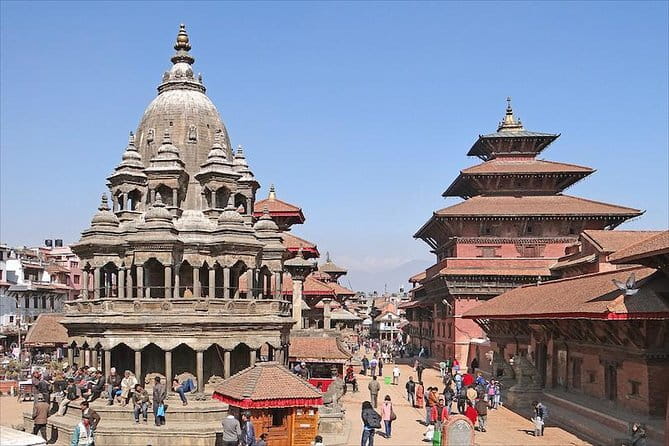
Pashupatinath Temple is the first stop for a reason. It’s the oldest Hindu temple in Kathmandu, and it centers on Lord Shiva through the sacred linga (the holy symbol) housed inside the ornate pagoda-style structure.
What I’d pay attention to here:
- The way the temple architecture signals significance, not just worship
- The sacred linga focus, which helps you understand that this isn’t a casual sightseeing stop
The details matter because Pashupatinath isn’t only a landmark. It’s a living place of devotion, and your guide can help you notice the patterns of religious practice that make the site feel active even when you’re standing still.
Timing is about 1 hour, and the admission ticket is included. That’s helpful if you want to spend more of your short day inside the complex rather than doing ticket checks and waiting around.
Durbar (Central) Square: Where Royal Power Played Out in Stone
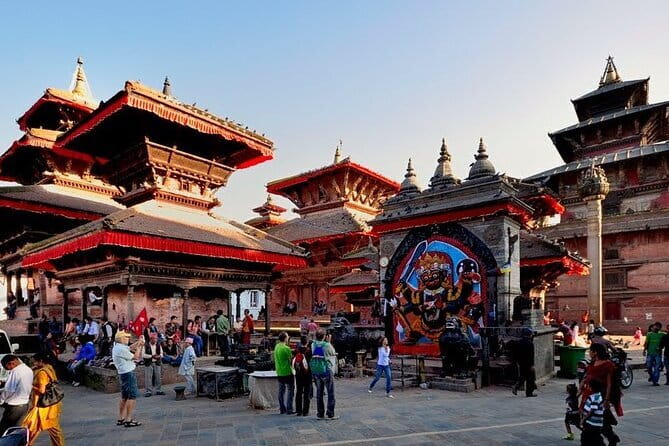
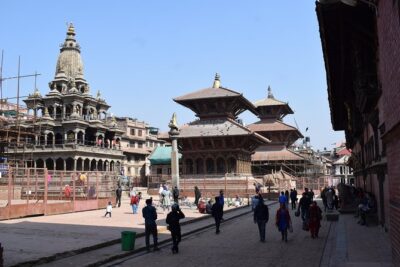
Next comes Durbar (Central) Square, and this is where the day gains a different flavor. This isn’t purely about one temple; it’s about how the city organized authority and ceremony over centuries.
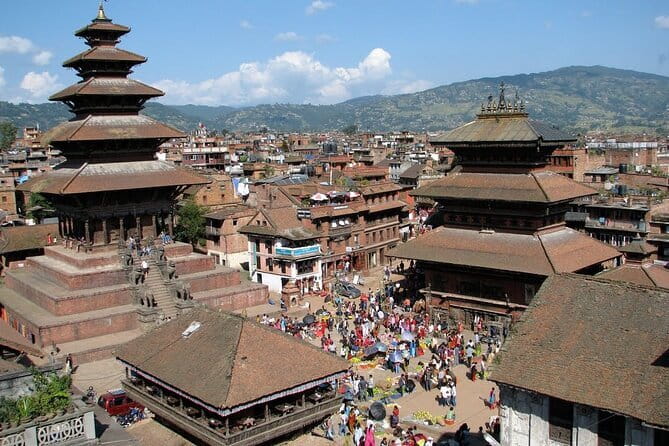
Durbar Square is tied to the Malla kings and their reforms, with much of the current architecture dating to the 1600s during the reign of King Siddhi Narsingh Malla. If you’re the type who likes to read a city with your eyes, Durbar Square gives you that. Even the layout feels like a map of where people gathered and where power was displayed.
A few context anchors you’ll hear:
- The site is connected to earlier settlements around the area
- It’s described as an ancient crossroad
- The Malla kings made important changes, shaping what you see today
You’ll spend about 1 hour 20 minutes here, with admission included. The trade-off is simple: it’s a busy historic core, so you’ll move through it at human speed, not as a slow museum stroll.
If you’re hoping for a quiet, empty space, Durbar Square may disappoint. But if you want to see how Kathmandu’s monarchy-era culture still shows up in streets and buildings, it’s an excellent stop.



Boudhanath Stupa: Giant Eyes, Mandala Steps, and Everyday Devotion
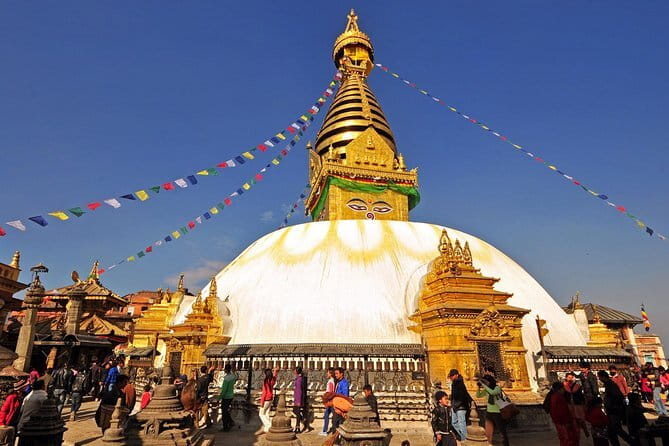
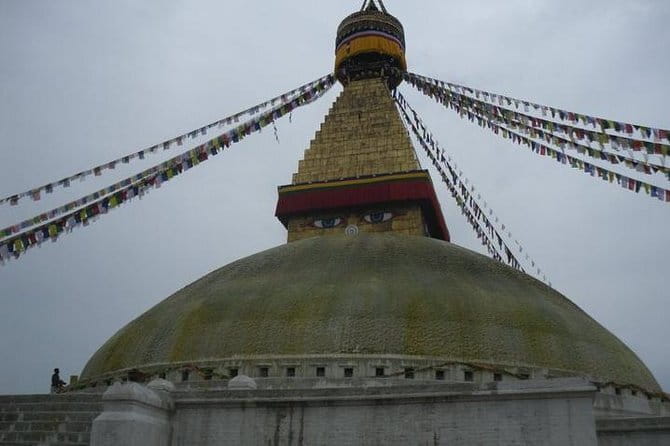
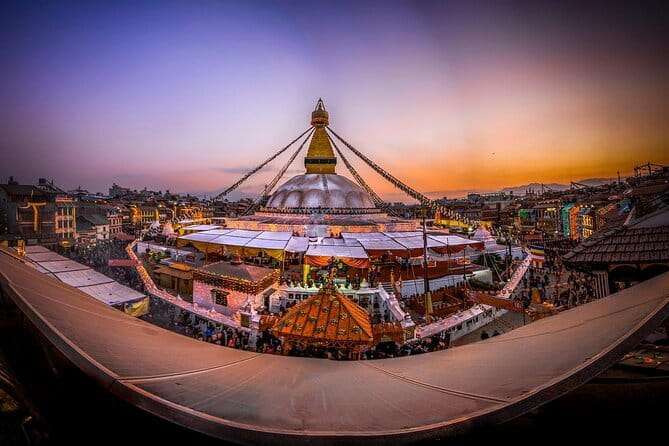
Then you hit Boudhanath Stupa, one of the most recognizable Buddhist monuments in the Kathmandu Valley. This place is described as a beacon of Buddhist belief for hundreds of years, and it towers over the surrounding town.
What stands out fast:
- The huge dome
- The pyramid tower on top
- The “giant eyes” image that people associate with this stupa
You’ll also hear the origin story: it’s said to have been built around the 14th century, and the description connects it to the period after the passing of the Buddha. Whether you view that as legend, tradition, or both, it helps explain why this stupa became such a major focus for worship and offering.
One detail that’s worth listening for is the stepped design. The stupa sits on large steps shaped like mandalas, and the monument is tied to an important trade route. That trade-route angle matters, because it frames Boudhanath not as a remote shrine, but as a center that drew people through travel and commerce.
You’ll spend about 1 hour here, and admission fees are included. It’s a good balance: enough time to notice the structure, take in the mood, and let your guide explain how Buddhist worship operates around a stupa.
Possible drawback: Boudhanath’s popularity means you may share your viewpoint with other visitors. If you’re trying to get the perfect photo with no bodies in it, you might need patience.
Swayambhunath Temple: UNESCO Status and the Wheel-and-Spire Story

The final stop is Swayambhunath Temple, also called Swayambhu. This one brings altitude into the day and a sense of viewpoint and pilgrimage in one package.
Here’s what the tour data highlights:
- Swayambhu is a UNESCO World Heritage Site
- Written records mention the Great Stupa as far back as the 5th century
- The stupa has been restored and repaired multiple times
You’ll get several restoration milestones, including damage in 1349 and later repairs. Another set of details is especially fun if you like architecture timelines:
- In 1505, a yogin named Sangye Gyaltsen added the wheel and spire to the dome
- In 1614, the 6th Shamarpa had shrines built into the stupa in four cardinal directions
- In 1750, Kagyu lamas held a consecration ceremony after a major renovation
These details help you see the stupa not as a single moment in time, but as a structure that keeps getting renewed. That makes the site feel less like a photo location and more like a project that generations cared about.
You’ll spend about 1 hour 10 minutes, with admission included. One practical consideration: Swayambhunath is a temple complex, so you’re likely to move around a bit to see key areas. If you’re feeling tired, this is where you’ll appreciate the group size control and the guide keeping things on track.
Timing, Group Size, and Tickets: How the Day Feels in Real Life
The day runs about 6 to 7 hours, and the schedule allocates time per stop rather than leaving everything open-ended. That’s valuable, especially if you have only a day in Kathmandu.
The no-more-than-15 group cap is more than a marketing line. In a city like Kathmandu, small group pacing matters because too many people can slow down entrances, photos, and explanations. With this cap, you still get group energy, but you’re less likely to spend your day waiting in a knot of strangers.
Also, admission is included at each of the main cultural stops: Pashupatinath, Durbar Square, Boudhanath Stupa, and Swayambhunath. That reduces surprise costs. It also helps you stay on schedule, since you’re not hunting for tickets right before you want to enter.
Food and drinks are not included unless specified. So if you’re hungry, you’ll likely handle meals on your own. I’d plan simple and flexible: don’t schedule a meal frenzy between sites, because the day is set up around the monument visits.
Price and Value: What $165 Covers (and What It Doesn’t)
At $165 per person, this tour isn’t the cheapest way to see Kathmandu. But it’s also not just paying for a guide and hoping transport shows up.
From the included list, you’re paying for:
- Hotel pickup and drop-off from Thamel
- Private vehicle transport plus a driver/guide
- Local taxes and fuel surcharge
- Entry fees for the temple and monastery stops
- A setup that includes a mobile ticket
What’s not included:
- Landing and facility fees
- Food and drinks, unless specified
The value equation is straightforward. Four major attractions plus private transport plus hotel pickup can cost a lot if you price them one by one. Here, the cost is bundled, so you can compare it to what you’d spend cobbling together taxis, ticket lines, and lost time.
If you’re traveling in a small group anyway, this kind of day tour often works out well. If you’re the type who only wants one or two sites and plenty of free time, then the fixed schedule might feel limiting.
Who This Tour Fits Best (and Who Might Skip It)
I think this tour is a strong match if:
- It’s your first time in Kathmandu and you want an organized introduction
- You like religious architecture and want context, not just snapshots
- You prefer fewer moving parts and less negotiation for transport
- You want a small group day that still feels social
It may be less ideal if you want:
- A slow, independent day with no structure
- Total flexibility to linger for as long as you like at one site
- A day focused on only one religion or only one type of attraction
One more note from practical experience: Kathmandu can be tricky for first-timers. Guides and staff matter. Past comments highlight guides like Raju for English skills and Subash and Drubha/Dhruba for quick problem-solving and attentive support for different needs, including a photography-focused group. That suggests the human side is taken seriously here.
Should You Book This Kathmandu Day Tour?
If you want the fastest path to understanding Kathmandu’s spiritual and royal heritage in one day, I’d book this. The big strengths are simple: small-group pacing, hotel pickup from Thamel, and entry tickets included for the four major monuments.
I’d pass or look for an alternative if you want a long, unstructured day or you plan to spend hours at just one place. Also, if you’re budgeting down to every last rupee, double-check what meals and any extra local fees might cost you.
Otherwise, this is a solid first-day plan: you’ll leave with a clearer mental map of Kathmandu and a set of unforgettable landmarks—Pashupatinath’s Shiva symbolism, Durbar Square’s monarchy-era architecture, Boudhanath’s stupa presence, and Swayambhunath’s UNESCO timeline.
FAQ
How long is the Small-Group Day Tour of Kathmandu?
It runs about 6 to 7 hours.
What are the main stops on the tour?
You visit Pashupatinath Temple, Durbar (Central) Square, Boudhanath Stupa, and Swayambhunath Temple.
Is pickup included?
Yes. The tour includes hotel pickup and drop-off, with transfers offered from Thamel hotels.
What is the group size limit?
The group is no more than 15 people.
Is this tour private?
The tour is private for your group, meaning only your group participates.
Are entry fees included?
Yes. Entry fees for the temple and monastery stops are included.
Does the tour include food and drinks?
Food and drinks are not included unless specified.
Is there a mobile ticket?
Yes. A mobile ticket is included.
What days and hours does the tour operate?
The provided operating window is Monday through Saturday, from 12:15 AM to 11:45 PM.
What is the cancellation policy?
You can cancel for a full refund up to 24 hours in advance of the experience’s start time.
More Tours in Kathmandu




More Tour Reviews in Kathmandu




Just Reviewed in Kathmandu
- Mountain Bike Tour
★ 5.0 · 3 reviews - Annapurna Panaroma
★ 5.0 · 3 reviews - Mount Everest Scenic Flight 50 Minutes
★ 5.0 · 3 reviews - Kathmandu : Swambhunath & Durbar Square Guided Half Day Tour
★ 3.3 · 3 reviews - Chandragiri Cable Car & Monkey Temple Tour – Private/Group
★ 5.0 · 3 reviews - Kathmandu: Shivapuri National Park Hiking Day Trip
★ 3.3 · 3 reviews
Tours, compared.
 ★ 5.0Everest Base Camp Helicopter Tour landing at Everest View HotelFrom $1,575668 reviews
 ★ 5.0Full Day 7 UNESCO Tour with Lunch – Private/GroupFrom $10415 reviews
 ★ 5.0Private Bhaktapur and Nagarkot Day Tour From KathmanduFrom $20305 reviews
 ★ 4.9Food and Drink Walking TourFrom $34292 reviews
 ★ 5.0Full Day Top 4 UNESCO Tour with Lunch – Private/GroupFrom $10269 reviews
★ 5.0Kathmandu Food and Drink Walking TourFrom $36266 reviews
 ★ 5.0UNESCO Seven World Heritage Tour in KathmanduFrom $180253 reviews
★ 4.9Full-Day 7 UNESCO Tour with Lunch – Private/GroupFrom $5247 reviews