
Review · KATHMANDU UNESCO HERITAGE TOURS
UNESCO Seven World Heritage Tour in Kathmandu
Seven UNESCO stops in one day sounds intense. It’s a tight-route Kathmandu Valley tour built to cover the big-name sites with private car time-savers and an English guide like Shanti along for the story.
I love that entry tickets for the heritage stops are handled for you, so you can focus on what you’re seeing instead of ticket lines. I also like the human touch from guides such as Pankaj and Kabita, who keep the day moving without feeling rushed.
One real drawback: this is a long day with lots of steps, starting with the 365 stairs at Swayambhunath and continuing with hill-temple climbing near Changu Narayan.
In This Review
- Key highlights at a glance
- Why a one-day UNESCO sweep makes sense in Kathmandu Valley
- Price and logistics: what $180 really covers
- Swayambhunath and Amideva Buddha Park: stairs, prayer wheels, and the view
- Kathmandu Durbar Square and Kumari Chowk: the royal-goddess courtyard stop
- Patan Durbar Square, the Golden Temple, and a museum with a surprise topic
- Bhaktapur’s temples plus Siddha Pokhari: pagodas, windows, and a pond break
- Changu Narayan: the hilltop temple that takes real time
- Pashupatinath and Boudhanath: two faiths, plus big-scale sacred architecture
- How your guide and driver shape the whole day
- Walking and timing tips: do not underestimate the steps
- Who should book this UNESCO Kathmandu day tour
- Should you book this Seven World Heritage day tour?
- FAQ
- How long is the UNESCO Seven World Heritage tour in Kathmandu?
- Where is the tour located?
- Is hotel pickup and drop-off included?
- Is this a private tour?
- What does the $180 per person price include?
- Is lunch included?
- Are entry tickets included?
- What should I wear?
- How far in advance is this tour commonly booked?
- What is the cancellation policy?
Key highlights at a glance
- Seven UNESCO properties in one day across temples, squares, and stupa sites
- Private car routing that cuts down time lost to Kathmandu traffic
- Guides who pace with you and explain both Hindu and Buddhist context
- Admission fees included for the UNESCO heritage sites
- Bhaktapur stops beyond the main square like Nyatapola, 55 Window Palace, and Siddha Pokhari
Deeper into old Kathmandu
- Private Kathmandu Sightseeing Tour | UNESCO World Heritage sites★ 5.0 · 756 reviews
- UNESCO Seven World Heritage Tour in Kathmandu★ 5.0 · 253 reviews
- Nepal Discovery Tour: Heritage Sites & Scenic Hill Easy Hike★ 5.0 · 121 reviews
- Kathmandu Private Sightseeing Tour | UNESCO World Heritage Sites★ 5.0 · 109 reviews
Why a one-day UNESCO sweep makes sense in Kathmandu Valley
Kathmandu Valley spreads its famous sights out across neighborhoods that don’t always feel connected on foot. This tour is designed for the problem you’ll run into on a short trip: you want to see the UNESCO list, but you also don’t want to spend half your time commuting.
The key value here is structure. Instead of you trying to stitch the day together solo, you get a private vehicle and guide who build a route that targets the UNESCO stops and then supports the extra context around them. That means your day feels like a guided storyline, not a scavenger hunt.
It also helps that the experience is private in practice. It’s only your group in the car, which usually makes it easier to set a pace that fits you, ask questions, and stop when something grabs your attention.
Price and logistics: what $180 really covers
At $180 per person, the headline cost is only half the story. What matters is what you get for that money: hotel pickup and drop-off, a private vehicle, an English-speaking guide, and admission fees for the seven UNESCO heritage sites.
Lunch is the main extra you’ll need to plan for. The tour specifically notes lunch in Bhaktapur is not included, and you can pick from eateries you’ll find there. Tips and gratuities are also not included, so budget a little extra for that if you plan to thank your guide and driver well.
Duration is about 12 hours. That’s not a short sightseeing burst, and it’s best seen as a full-day commitment with an early start. One review mentions a 7am beginning, and even if your timing differs, the spirit is the same: expect an early kickoff and a day that runs late enough to feel like you lived through the city.
Dress code is smart casual. You’ll be moving around temples and courtyards, and you’ll do better if you dress for comfort more than style.
Swayambhunath and Amideva Buddha Park: stairs, prayer wheels, and the view
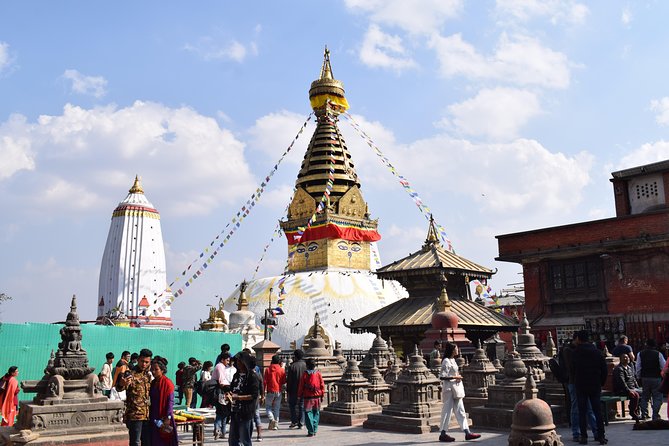
You start at Swayambhunath Stupa, nicknamed the Monkey Temple, perched on top of Kathmandu. The big functional detail is the climb: it’s described as having 365 stairs to reach the top viewpoint area. That number sounds cute until you’re halfway up with warm air and a camera strap digging into your shoulder—so wear shoes you trust.
Once there, the tour experience leans into atmosphere. You can move around the stupa and spin prayer wheels, and the site also includes Hindu temples and deities co-existing within this Buddhist space. If you’re the kind of person who likes to see how religions overlap in daily life, this is a strong opening act.
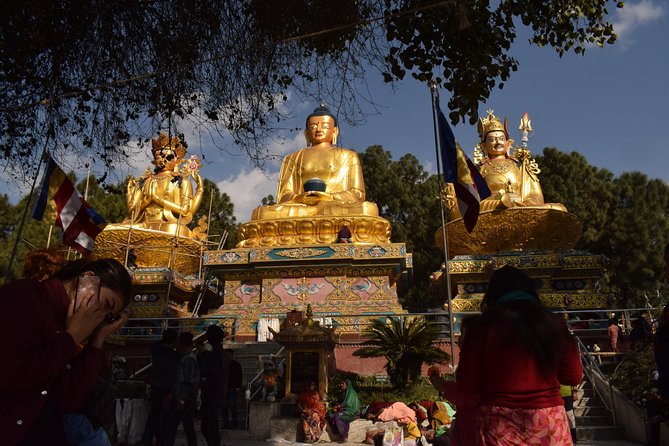
Time here is short on paper—about 15 minutes—but your guide can use that time well if you have questions. Afterward, you head to Amideva Buddha Park nearby. The stop focuses on three big Buddha statues and gives you a quick change of pace from the stupa climb.
Both sites are listed with admission tickets included, and the way the tour pairs them makes sense: you start high for the sweeping feel, then step into a calmer area with statues instead of constant stair-and-crowd movement.
Kathmandu Durbar Square and Kumari Chowk: the royal-goddess courtyard stop
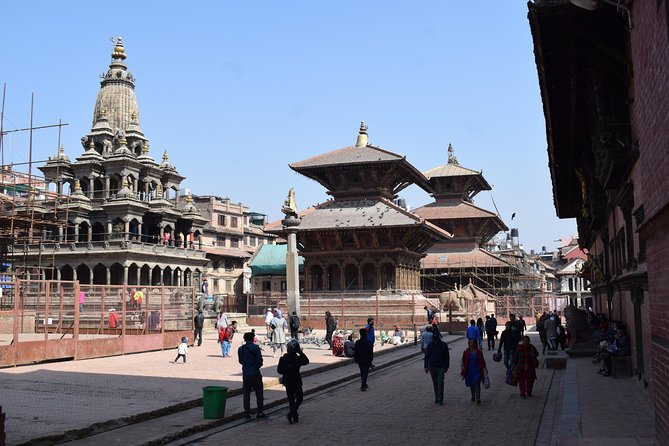
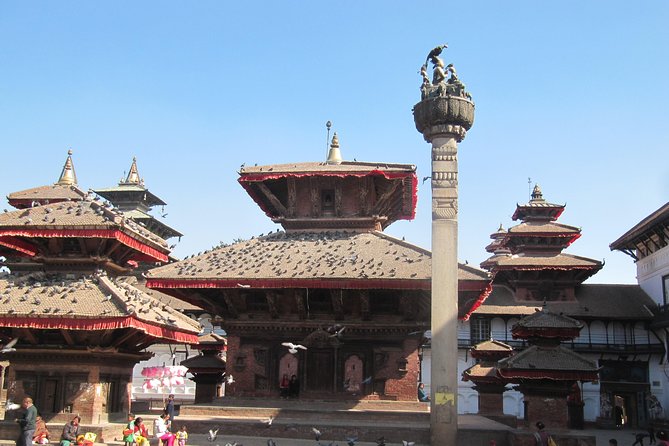
From Swayambhunath, you move toward the heart of historic Kathmandu. The tour’s Kathmandu Durbar Square area is described as having historical and religious structures, with some in reconstruction but still enough to explore and photograph.
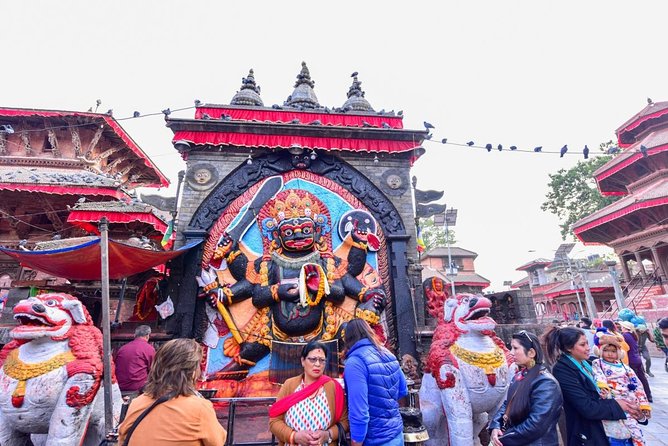
A highlight in this zone is Kumari Chowk. This is a courtyard inside a red-brick, three-level building that was once home to Kumari, a girl selected to be the town’s living goddess until puberty and then becoming a mere mortal. Even if you don’t catch the full spectacle of Kumari’s presence, the stop gives you a clear window into how the city treats sacred roles in real life, not just as legend.
This is also one of the moments where a good guide can save you. With so many temples and details in one day, you’ll appreciate explanations that translate what you’re looking at, instead of letting you guess.
The itinerary notes admission tickets included here, and the stop is set at about 10 minutes for Kumari Chowk.
Patan Durbar Square, the Golden Temple, and a museum with a surprise topic
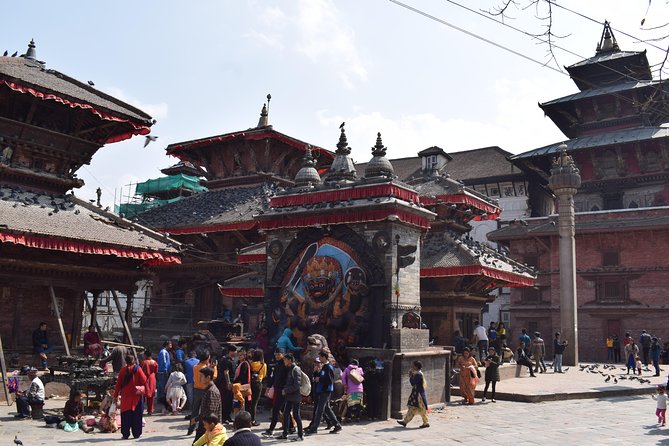
Next you head toward Patan, known for Newari architecture and a strong local craft presence. The tour includes Patan Durbar Square, described as the courtyard of the old Malla palace, packed with Newari architectural style and nearby Newar community.
Then you go to the Golden Temple (Hiranya Varna Mahavihar). This is listed as a 12th-century pagoda-style temple with bronze statues and silver elements. If you like the feel of metalwork and reflective religious design, this stop is the kind that gives you something visual right away.
After that, you step into Patan Museum, set in Keshav Narayan Chowk. The museum stop is framed as a place to learn about tradition and history, including a section about historic Japanese civilization. That specific angle is unusual enough that it can be a nice mental breather from temple-to-temple walking.
The museum timing is about 15 minutes, which means it’s more of a highlight stop than a full museum session. Still, it’s a smart way to add context without losing momentum.
If you’re worried about fatigue, this portion may help. You’re not climbing as relentlessly as Swayambhunath, and you’re getting a different kind of learning that can reset your attention.
Bhaktapur’s temples plus Siddha Pokhari: pagodas, windows, and a pond break
Bhaktapur is described as the City of Devotees, with older-style houses and constructions left intact. In a day that already feels dense, this part matters because it slows the pace in a different way: you start seeing repetition of form—temple towers, courtyard details, and carved elements—until the city starts to feel like one connected visual language.
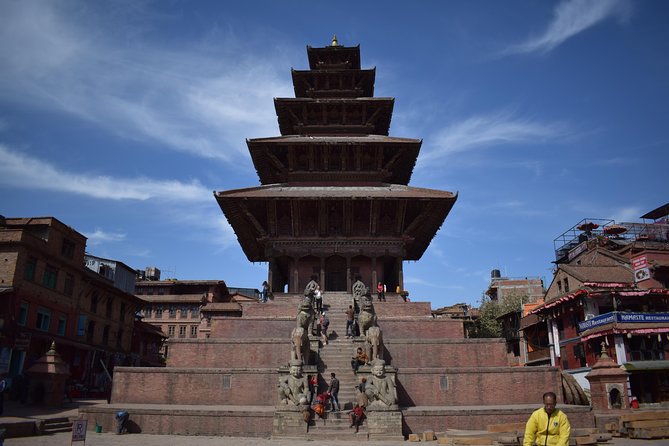
The first major stop in this block is Nyatapola Temple. It’s described as a pagoda-style temple with five roofed levels, and the building is noted for its sculpted design and being among the tallest pagodas.
Then you move to Dattatreya Temple in Dattatreya Square. A standout detail from the description: it’s believed to have been built using the resource of a single stem of a single tree. Whether or not you go deep into the craft history, the fact that the tour calls out that claim tells you the guide will point out what makes the temple structurally and symbolically interesting.
Next comes 55 Window Palace, named for the carved fifty-five windows. Even if you don’t count them yourself, you’ll quickly see why this is a signature stop in Bhaktapur Durbar Square areas.
Finally, there’s Siddha Pokhari, a human-made pond near the first town gate, described as 171 meters long and three meters deep. It’s also described as a favorite hangout area. This is a useful practical stop because it gives you a non-temple moment during a day packed with steps.
Lunch in Bhaktapur is not included, and you’ll choose your own place. I like that freedom here. It lets you eat when you feel ready, instead of getting forced into a single set menu far from your actual walking route.
Changu Narayan: the hilltop temple that takes real time
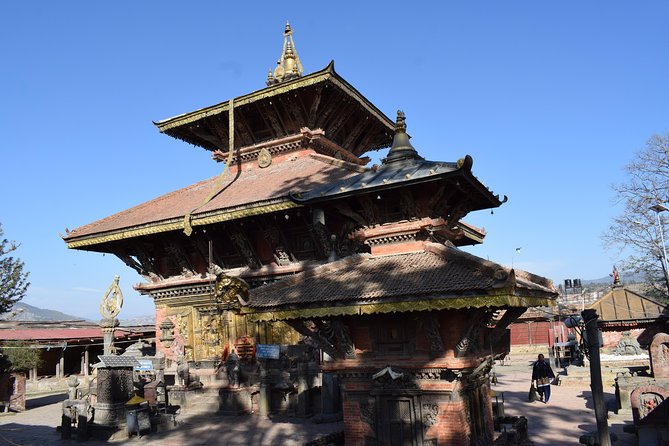
The tour includes Changu Narayan Temple, described as remote and on a hilltop. It’s also framed as one of the oldest temples in Kathmandu Valley and connected to the Licchavi period in the records of Nepal.
What makes Changu Narayan a smart placement on this itinerary is the timing: it’s listed for about 1 hour, which is longer than most temple stops on the day. That extra time is where you can catch up if your morning started faster than planned, or if you like reading the carving details before you move on.
The description highlights the temple being made of lovely stone and wooden carvings. So in practice, this stop tends to be the one where you go from seeing temples as landmarks to noticing the craft—how the design uses materials and depth to create texture.
Because it’s a hilltop visit, plan energy for walking. If stairs wear you out, treat this as the point in the day where you slow down and breathe.
Pashupatinath and Boudhanath: two faiths, plus big-scale sacred architecture
After Changu Narayan, the tour shifts toward two heavyweight sacred sites: Pashupatinath Temple and Boudhanath Stupa.
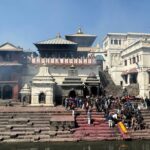
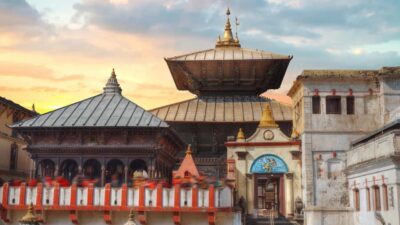
At Pashupatinath, the complex is described as one of Nepal’s largest temple complexes, housing more than 500 temples and shrines and covering 0.64 hectares. This is a great moment to let your guide do the heavy lifting. With that many shrines, you’ll either get lost in a sea of details or you’ll get a clear storyline for what you’re seeing.
The stop is listed at about 1 hour. That matters, because it gives time to understand the layout and not just take a quick look and run.
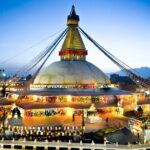
Then you go to Boudhanath Stupa, described as a major Buddhist pilgrimage site with a 36-meter-tall mandala form. The tour notes over 50 gompas built around it, which reinforces why your attention will bounce between the stupa itself and the surrounding religious buildings.
This pairing of sites works well because the day already covered Hindu-associated details earlier, and then it gives you a full Buddhist stupa experience before the day ends. You’ll feel that change in your head as much as in the architecture.
How your guide and driver shape the whole day
A day tour like this rises or falls on pacing and communication. The reviews for this experience repeatedly praise guides by name—Shanti, Pankaj, Kabita, Sarita, Som. The common theme is that the guide stays friendly and keeps you from feeling rushed, even when the schedule is packed.
This shows up in small decisions: stopping long enough for questions, adjusting time for what you care about, and managing the flow between sites so you don’t feel stranded between two entrances. One review even highlights that the guide invited questions and kept the pace at the group’s comfort.
Your driver matters too. Kathmandu traffic is its own character, and the tour relies on a driver who can handle busy roads while keeping you safe. Multiple reviews mention a professional approach and a smooth experience getting in and out of the car.
If you like photos, there’s another useful point: some guides are described as helping with picture timing. That matters because it’s not just about taking photos; it’s about taking them when the light and crowd density are reasonable, instead of forcing it.
Walking and timing tips: do not underestimate the steps
This tour is action-packed in a real, physical way. Besides the 365 stairs at Swayambhunath, you’ll also be dealing with stair climbs and walking at temple-heavy sites throughout the day.
Here’s what I recommend you do before you go:
- Wear comfortable walking shoes with grip.
- Bring sun protection and refill water when you can.
- If you know you tire easily, tell your guide early so they can pace you.
The stop durations suggest short visits, but the day still totals about 12 hours. That can feel easier with breaks and good timing, which is exactly why the private car and guided route matter.
Also plan for one more reality: reconstruction areas in Kathmandu Durbar Square can change what you’re able to see up close. If you’re relying on perfect photos, you’ll be happier treating the day like a history and architecture tour with real-world conditions.
Who should book this UNESCO Kathmandu day tour
You’ll likely love this tour if:
- You’re visiting Kathmandu with limited time and want to see the UNESCO list in one day.
- You like temples, squares, and sacred architecture with explanations that connect the dots.
- You prefer a private setup where you can ask questions and control your walking pace a bit.
You may want a different plan if:
- You have mobility limits or you know you struggle with lots of stairs.
- You’d rather spend half a day in one museum or one neighborhood instead of stacking many sites in a single schedule.
- You’re hoping for a relaxed, late-start day with minimal walking.
Should you book this Seven World Heritage day tour?
If your priority is orientation and UNESCO checkmarks, this is a strong buy. You’re paying for a private vehicle, hotel pickup/drop-off, an English guide, and admission fees for the core UNESCO stops. In return, you get a full-day route that helps you understand Kathmandu Valley as a set of connected sacred places, not isolated postcard dots.
Just go in with eyes open. The biggest reason to hesitate is the physical load: steps and hilltop climbing appear multiple times, and the day runs long. If you’re ready for that trade, this tour is one of the fastest ways to get a true Kathmandu Valley snapshot.
If you’re not sure, pick based on your stamina first, then based on how much you value a guided route over flexible self-exploration.
FAQ
How long is the UNESCO Seven World Heritage tour in Kathmandu?
It runs about 12 hours (approx.).
Where is the tour located?
The tour takes place in Kathmandu, Nepal, covering Kathmandu Valley’s UNESCO heritage sites.
Is hotel pickup and drop-off included?
Yes. Hotel pick up and drop off are included.
Is this a private tour?
Yes. It’s a private tour/activity, and only your group will participate.
What does the $180 per person price include?
The tour includes a private vehicle, an English-speaking guide, all required entry fees in the 7 heritage sites, and hotel pickup and drop-off.
Is lunch included?
No. Lunch in Bhaktapur is not included, and you choose your own place.
Are entry tickets included?
Yes. All required entry fees for the 7 heritage sites are included.
What should I wear?
The dress code is smart casual.
How far in advance is this tour commonly booked?
On average, it is booked 37 days in advance.
What is the cancellation policy?
Free cancellation is available up to 24 hours before the experience start time for a full refund. If you cancel less than 24 hours before, the amount paid is not refunded.
The Old Kathmandu, Properly Toured

More Tours in Kathmandu


More Tour Reviews in Kathmandu

Just Reviewed in Kathmandu
- Mountain Bike Tour
★ 5.0 · 3 reviews - Annapurna Panaroma
★ 5.0 · 3 reviews - Mount Everest Scenic Flight 50 Minutes
★ 5.0 · 3 reviews - Kathmandu : Swambhunath & Durbar Square Guided Half Day Tour
★ 3.3 · 3 reviews - Chandragiri Cable Car & Monkey Temple Tour – Private/Group
★ 5.0 · 3 reviews - Kathmandu: Shivapuri National Park Hiking Day Trip
★ 3.3 · 3 reviews
Kathmandu UNESCO Heritage Tours, compared.
 ★ 4.87 UNESCO Sites with LunchFrom $2744 reviews
 ★ 5.0Full Day 7 UNESCO Tour with Lunch – Private/GroupFrom $10415 reviews
 ★ 5.0Full Day Top 4 UNESCO Tour with Lunch – Private/GroupFrom $10269 reviews
★ 4.9Full-Day 7 UNESCO Tour with Lunch – Private/GroupFrom $5247 reviews
★ 5.0Full Day Top 4 UNESCO Tour with Lunch – Private/GroupFrom $10269 reviews
★ 4.9Full-Day 7 UNESCO Tour with Lunch – Private/GroupFrom $5247 reviews
 ★ 4.97 UNESCO Sites Tour in 1 Day (Private Tour)From $4204 reviews
 ★ 4.9Top 4 UNESCO Tour with Lunch – Private/GroupFrom $5181 reviews
 ★ 5.0Kathmandu Private Sightseeing Tour | UNESCO World Heritage SitesFrom $35109 reviews
★ 5.0Full Day 7 UNESCO Tour with Lunch – Private/GroupFrom $5101 reviews
★ 5.0Kathmandu Private Sightseeing Tour | UNESCO World Heritage SitesFrom $35109 reviews
★ 5.0Full Day 7 UNESCO Tour with Lunch – Private/GroupFrom $5101 reviews
Browse the lists this tour appears in