
Review · SWAYAMBHUNATH MONKEY TEMPLE TOURS
Monkey Temple – Swayambhunath Tour – Private/Small Group
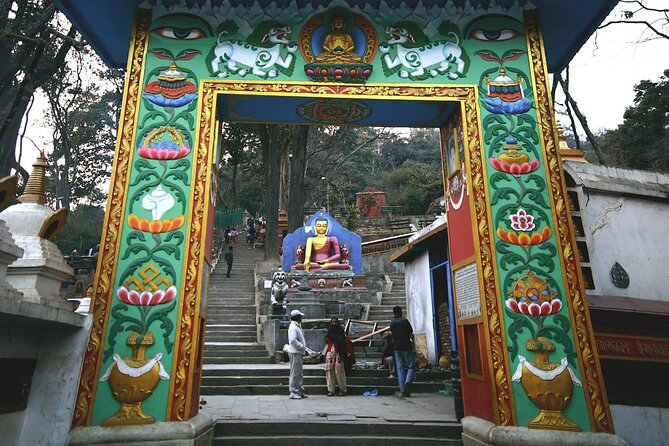
Monkey Temple rewards a morning walk. This private/small-group Swayambhunath tour pairs temple time with myth-busting explanations as you stroll through Kathmandu neighborhoods toward the hilltop stupa. I like that you’re not just ticking off a monument; you’re also getting the stories behind why the Kathmandu valley matters, and how Hindu and Buddhist devotion overlap. One thing to plan for: the approach involves 365 stairs, and you’ll add a small cash entrance fee at Swayambhunath.
I also like the value math. For $15, you get an English-speaking guide, multiple meaningful stops around Swayambhu, and guided photo-friendly viewpoints without the chaos of a huge bus group. If you’re lucky, you may get Santosh, who’s known for taking his time and explaining the mix of Hinduism and Buddhism in plain language. The tradeoff is simple: it’s a walking-heavy, moderate-fitness outing, so if you have knee issues or severe asthma, this may not be your best match.
In This Review
- Key things to know before you go
- Why Swayambhunath feels different from other Kathmandu temple stops
- Meeting in Thamel: a guided walk that helps you understand Kathmandu fast
- Bhagwan Pau and the 365 stairs: where your pacing (and knees) matter
- Reaching the Monkey Temple: stupa time plus origin myths of Swayambhunath
- World Peace Pond and the statue details you’ll want to notice
- Harati Ajima: pagoda-style architecture and the Mother Harati story
- Manjushree Temple and the western-side panoramic viewpoint
- Amideva Buddha Park: the huge statues that make the tour feel larger
- Adding in Shova Bhagawati: a glimpse of devotion near the Bishnumati River
- Price and entrance fees: getting real value for $15
- Practical tips: how to make the stairs and walking feel easier
- Who this tour is best for
- Should you book Monkey Temple – Swayambhunath Tour?
- FAQ
- How long is the Monkey Temple – Swayambhunath tour?
- What’s the group size for this tour?
- Where does the tour start and end?
- Is there an entrance fee for Swayambhunath?
- What’s included in the price?
- What is not included?
- Does the tour run in English?
- Is the tour suitable for people with mobility issues?
- How does youth pricing work?
Key things to know before you go
- Max 5 people means you’ll move at a human pace and actually hear the guide.
- Myths + origins: you’ll connect Swayambhunath legends to the origin story of the Kathmandu valley.
- 365-stair climb up from Bhagwan Pau to the hilltop entrance.
- More than one shrine: Harati Ajima, Manjushree Temple, Amideva Buddha Park, and more.
- Big sculpture time at Amideva Buddha Park, with 67-foot and 64-foot statues.
- Thamel start point makes it easy to join without getting lost in transit.
Just your group, at your own pace
- Private Kathmandu Sightseeing Tour | UNESCO World Heritage sites★ 5.0 · 756 reviews
- Kathmandu: Full Day 7 UNESCO Tour with Lunch – Private/Group★ 5.0 · 415 reviews
- Private Bhaktapur and Nagarkot Day Tour From Kathmandu★ 5.0 · 305 reviews
- Kathmandu: Full Day Top 4 UNESCO Tour with Lunch – Private/Group★ 5.0 · 269 reviews
Why Swayambhunath feels different from other Kathmandu temple stops
Swayambhunath (often nicknamed the Monkey Temple) isn’t just visually dramatic. It’s also layered in meaning, because it sits at the intersection of Buddhist and Hindu belief—something you’ll feel as soon as you start walking the nearby lanes. Instead of treating it like a single big attraction, this tour frames it as a neighborhood of shrines and stories that orbit the stupa.
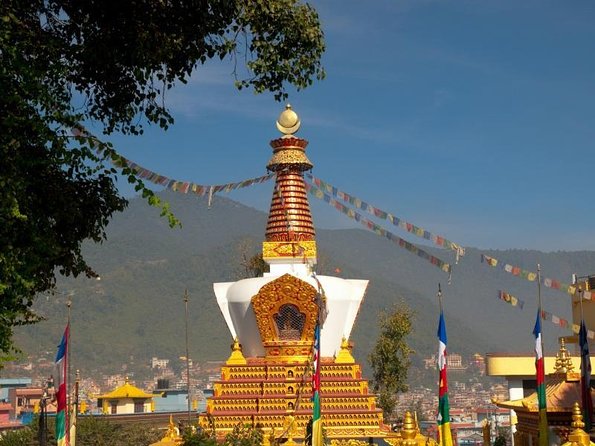
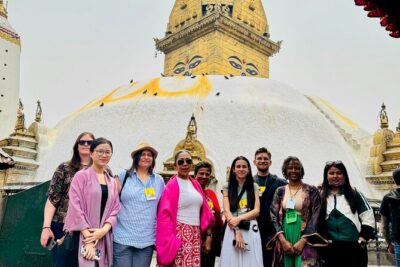
The “wow” factor is obvious when you reach the main area: Swayambhunath is one of Nepal’s holiest Buddhist stupas, perched up on a hill with views over Kathmandu. What makes the experience better is that the guide helps you read what you’re seeing—why particular symbols matter, what legends say about the site’s origin, and how nearby temples fit the same spiritual map.
Meeting in Thamel: a guided walk that helps you understand Kathmandu fast
Your tour begins at Pumpernickel Bakery in Thamel. That matters more than it sounds. Thamel is where most visitors base themselves, so you’re not spending precious time on confusing meetups or long rides. It also sets the tone: you’re moving through Kathmandu as a pedestrian, which is the most honest way to learn how neighborhoods feel at ground level.
Expect an easy start with time to get oriented. Before heading up toward the hill, you’ll pass religious sites tied to older Kathmandu stories. You’ll hear about the mythic setup of eight Matrikas said to have been established when King Gunakamdev made Kathmandu city—one of which is the Indrayani/Luti Ajima temple. You’ll also visit Bijeshwori Temple, sacred to both Hindus and Buddhists and important for Tibetan Buddhists through its Buddhist affiliation. The guide connects those dots so you understand why different communities value the same area.
If you’re the kind of traveler who likes to see how daily life sits next to sacred places, this opening stretch is where the tour earns its keep. It’s not only about the hilltop.
Bhagwan Pau and the 365 stairs: where your pacing (and knees) matter
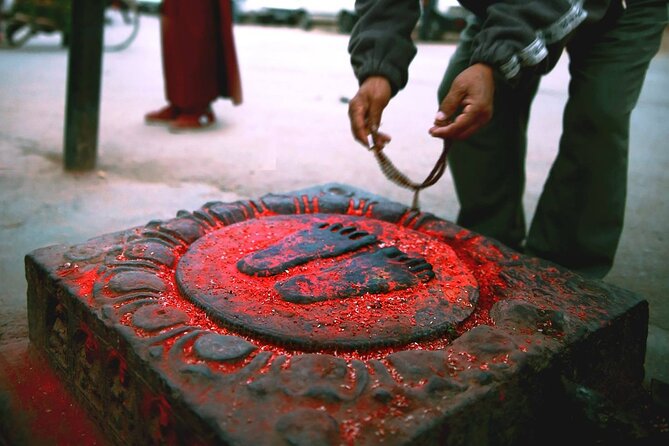
One of the key waypoints is Bhagwan Pau, the feet of Lord Buddha at the bottom of the Swayambhu hill. This is where you pause before committing to the stairs. The tour includes a break to rest, drink water, and get ready for the climb.
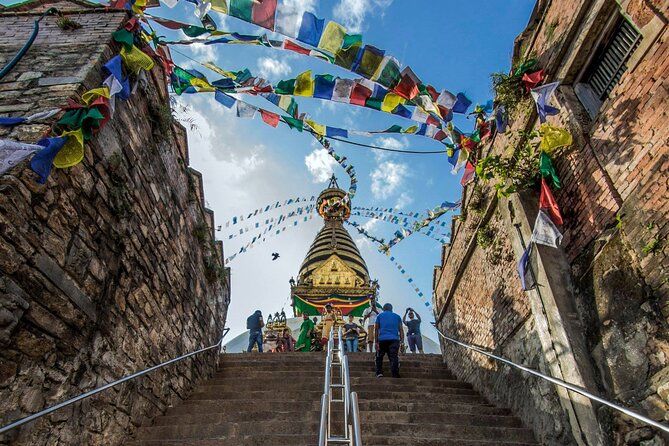
Then comes the main entrance approach: 365 stairs up to Swayambhunath. That number is part legend, part structure—you’ll see it because you have to climb it. If you keep an even pace, it feels manageable for most people with moderate fitness. But this is absolutely not the tour for travelers with knee problems or severe asthma. You’re better off choosing a gentler option if stairs are a hard stop for you.
Bring practical shoes. Kathmandu stone can be slippery, and the hill is cooler than street-level, which can affect how your legs feel as the walk goes on.
Reaching the Monkey Temple: stupa time plus origin myths of Swayambhunath
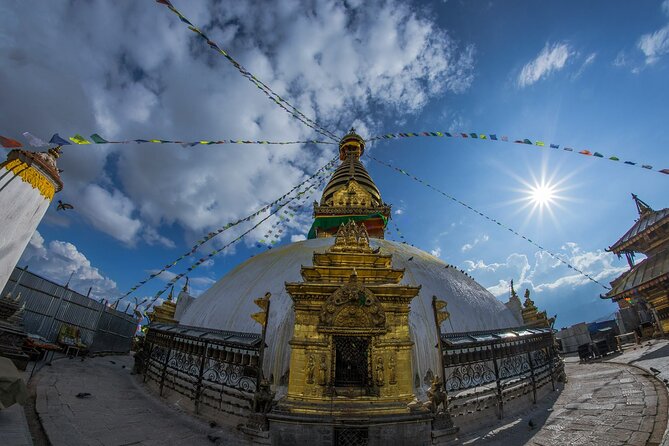
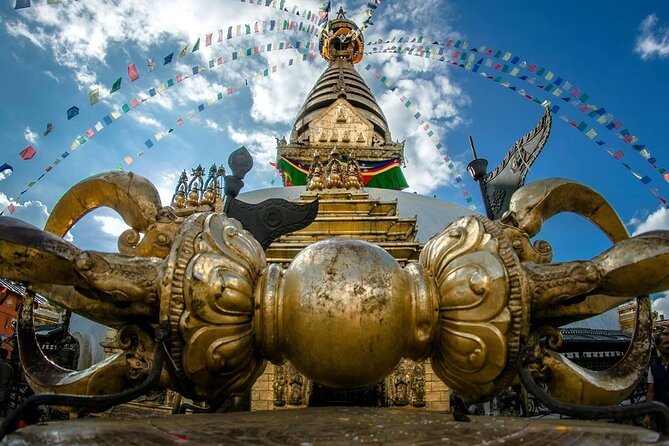
Once you arrive at Swayambhunath, the tour shifts from “getting there” to “understanding what you’re looking at.” The main goal is to explore the Swayambhu neighborhood and learn the lore and legends tied to the stupa’s origin, along with stories about how the Kathmandu valley formed.
This is where a good guide makes the difference between a photo stop and a meaningful visit. The best part isn’t only the stupa itself—it’s what surrounds it: the symbols, the religious practices you may see while you’re there, and the explanations that translate local myth into something you can actually follow. If religious ceremonies are happening during your visit, the guide helps you understand what’s going on rather than leaving you guessing.
You’ll also get a sense of how the hilltop works as a living religious space. Swayambhunath isn’t a museum; it’s still in use, and your time there will reflect that.

World Peace Pond and the statue details you’ll want to notice
On the western side of the Swayambhunath area, you’ll stop at the World Peace Pond. This is a smaller moment compared with the stupa, but it’s a nice one because it slows you down. In the middle of the pond sits a brass Buddha statue on a lotus flower, a visual focal point for the spot.
There’s also text written on the walls in English. That detail helps if you want to connect the setting to a broader theme—peace—without needing translation.
This stop is a good reminder that the tour isn’t only about climbing and big monuments. It also includes quiet, meaningful spaces that you can actually look at.
Harati Ajima: pagoda-style architecture and the Mother Harati story
Harati Ajima Temple is one of the most interesting stops because it highlights Nepal’s own architectural style—a pagoda-like form that feels distinctly local. The guide explains the legend of Harati, a demon who becomes Mother Harati, and why people around the Kathmandu valley worship her.
This is exactly the kind of temple story that can change your whole experience. Without context, you might only register a building and a name. With context, you understand the spiritual role of the figure being honored, and you notice the devotional patterns with more meaning.
It’s also a short stop, so you get the payoff without losing momentum. That’s part of what makes the tour feel efficient.
Manjushree Temple and the western-side panoramic viewpoint
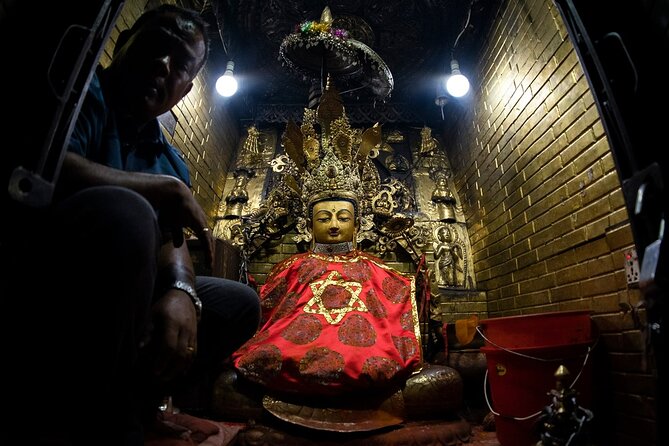
Next up is Manjushree Temple, dedicated to Maha Manjushree on Swayambhu Hill. Here the focus turns back to the big myth of the valley: legends about how Kathmandu Valley was turned into a city from a great lake.
The practical bonus is the viewpoint angle. The stop includes a panoramic look toward the western side of Kathmandu, which is one of the best reasons to do Swayambhu in the first place. Even if you don’t become a hilltop photographer, you’ll appreciate the way the city stretches out from here.
Amideva Buddha Park: the huge statues that make the tour feel larger
Amideva Buddha Park delivers the scale factor. You’ll walk around three gigantic idols: Amitabha Buddha (Amideva) in the center at 67 feet, and Chenrezig plus Padmasambhava on the sides at 64 feet each.
Even if you’re not a sculpture person, size is a language. The guide shares the stories tied to these figures, and walking the park makes the visit feel like a designed pilgrimage space rather than a random stop.
This is also a nice contrast to Swayambhunath itself. The stupa gives you spirituality in the “older, compact, layered” mode. Amideva Buddha Park gives you monumental, modern-in-feel presence, and the combination helps the overall tour feel balanced.
Adding in Shova Bhagawati: a glimpse of devotion near the Bishnumati River
You’ll also visit Shova Bhagawati, a holy shrine devoted to the goddess Bhagwati on the bank of the Bishnumati River. The tour notes that this temple is one of Kathmandu’s major Bhagwati temples, which matters because it reinforces that Swayambhu is part of a wider network of sacred sites.
You won’t need to know every detail of the goddess’s tradition to get value here. The guide’s role is to connect the shrine to the broader Kathmandu pattern—how religious worship is distributed across the city, not only concentrated at the famous hilltop.
Price and entrance fees: getting real value for $15
At $15 per person, this tour is priced for travelers who want depth without spending half a day (or a week’s budget). You get an English-speaking guide, the small-group advantage (up to 5 people), and a mobile ticket.
What’s not included is the one big extra cost you should plan for: Swayambhunath entrance fee is 200 rupees, paid in cash directly to temple authorities. It’s roughly $1.50 per person. Everything else on the route is listed as included admission at several stops, with the main Swayambhunath fee called out separately.
Practical takeaway: bring some Nepal rupees or be ready to withdraw cash before the visit. Also, keep your phone charged. A mobile ticket is included, and you’ll want it easy to show.
And yes, coffee and/or tea aren’t included. That’s not a dealbreaker, but it’s your cue to plan a simple water break and maybe grab a drink before or after your tour.
Practical tips: how to make the stairs and walking feel easier
This is a walking tour with moderate physical demands. It’s near public transportation, and service animals are allowed. Still, the hill approach and stair count are the real test.
- Wear shoes with grip. The surfaces can be uneven and worn.
- Pace yourself. You don’t win anything by sprinting the steps.
- If you have asthma that flares with exertion or knee pain, take the “not advised” note seriously.
- Bring a light layer. The hill area can feel cooler than Thamel.
- Expect some stops to be short. That’s how you fit this many shrines into about 3 hours.
If you’re a solo traveler, you’re not doing this alone in an intimidating way. A small group walking with an English-speaking guide tends to feel straightforward and safe. If you’re paired with a guide like Santosh, you should also expect patience and time to explain what you’re seeing, not just quick directions.
Who this tour is best for
This tour fits best if you want a guided walk that teaches meaning, not only location.
- You’ll enjoy it if you like mythology and origin stories tied to real places.
- It’s great for first-time Kathmandu visitors who want a fast, coherent introduction to Swayambhunath and nearby shrines.
- It’s ideal if you’re short on time but still want to see more than one temple site.
- It’s less ideal if stairs are a serious obstacle for you.
Should you book Monkey Temple – Swayambhunath Tour?
I’d book it if you want value plus context. The combination of a small group, an English-speaking guide, and multiple connected stops around Swayambhu makes the tour feel efficient without feeling rushed. You’re paying for more than a hilltop view; you’re paying for stories that help you read the place.
Pass or look for an easier alternative if stairs and knee strain are already a problem for you. And do remember the cash entrance fee for Swayambhunath, so you’re not scrambling at the last second.
If your travel style is walk, learn, look, and move on, this is a strong choice for Kathmandu.
FAQ
How long is the Monkey Temple – Swayambhunath tour?
It’s about 3 hours (approx.).
What’s the group size for this tour?
The group is limited to a maximum of 5 travelers.
Where does the tour start and end?
It starts at Pumpernickel Bakery (Paryatan Marg, Kathmandu 44600, Nepal) and ends back at the meeting point.
Is there an entrance fee for Swayambhunath?
Yes. Swayambhunath entrance fee is 200 rupees (about US$1.50) paid in cash directly to temple authorities.
What’s included in the price?
An English-speaking guide, mobile ticket, and included admission tickets for most stops listed on the route.
What is not included?
Coffee and/or tea are not included.
Does the tour run in English?
Yes, the guide is English speaking.
Is the tour suitable for people with mobility issues?
It requires a moderate physical fitness level, and it is not advised for travelers with severe asthma and knee problems.
How does youth pricing work?
Youth pricing is for students with a student card.
Private Days, Your Group Only

More Tours in Kathmandu

More Tour Reviews in Kathmandu

Just Reviewed in Kathmandu
- Mountain Bike Tour
★ 5.0 · 3 reviews - Annapurna Panaroma
★ 5.0 · 3 reviews - Mount Everest Scenic Flight 50 Minutes
★ 5.0 · 3 reviews - Kathmandu : Swambhunath & Durbar Square Guided Half Day Tour
★ 3.3 · 3 reviews - Chandragiri Cable Car & Monkey Temple Tour – Private/Group
★ 5.0 · 3 reviews - Kathmandu: Shivapuri National Park Hiking Day Trip
★ 3.3 · 3 reviews
Swayambhunath Monkey Temple Tours, compared.
 ★ 4.8Chandragiri Cable Car and Monkey Temple TourFrom $3139 reviews
 ★ 5.0Chandragiri Cable Car & Monkey Temple Tour- Private/GroupFrom $532 reviews
 ★ 5.0Private Chandragiri Cable Car and The Monkey Temple TourFrom $530 reviews
 ★ 5.0Guided Walking Tour with Monkey TempleFrom $1518 reviews
 ★ 5.0Kathmandu Chandrigiri Hill Cable Car & Monkey Temple UNESCO TourFrom $4816 reviews
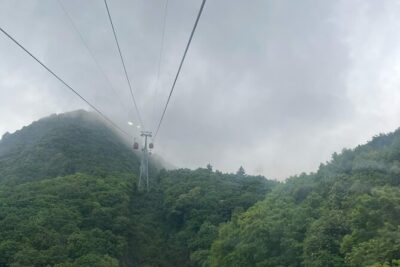 ★ 5.0Chandragiri Cable Car Ride & Monkey Temple Tour – Private/GroupFrom $513 reviews
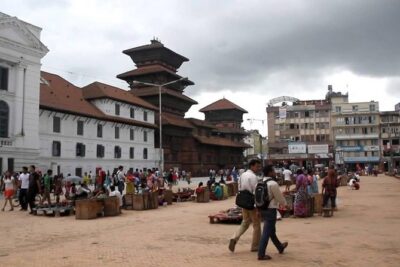 ★ 4.5Private Half-Day Tour of Kathmandu Durbar Square and Swayambhunath TempleFrom $4711 reviews
★ 5.0Chandragiri Cable Car and Monkey Temple TourFrom $759 reviews
★ 4.5Private Half-Day Tour of Kathmandu Durbar Square and Swayambhunath TempleFrom $4711 reviews
★ 5.0Chandragiri Cable Car and Monkey Temple TourFrom $759 reviews
Browse the lists this tour appears in