
Review · GUIDED
Kathmandu Guided Tour
Four hours of temple time in Kathmandu.
This guided route is interesting because you’re not just seeing famous spots; you’re getting the Hindu-and-Buddhist meaning behind the stones, statues, and symbols as you move between World Heritage sites by air-conditioned private vehicle. It’s culture, religion, and a little spirituality, packed into one easy plan.
Two things I really like: first, the tour hits the key anchors of the city—Kathmandu Durbar Square, Swayambhunath, Boudhanath, and Pashupatinath—so you get a connected story instead of a random checklist. Second, the format is calm and workable: you’ll spend about an hour at each stop, and the package covers the main entrances, so you can focus on looking and learning rather than figuring out fees.
One possible drawback: the schedule is tight. Even though it’s only 4 to 6 hours, you’ll be moving through major religious sites with crowds and lots to notice, so it’s not the best choice if you want long, slow wandering.
In This Review
- Key highlights you’ll feel right away
- How the Kathmandu Guided Tour runs in real life
- Kathmandu Durbar Square: palace temples and the living goddess
- Swayambhunath Monkey Temple: city views and hidden symbol details
- Boudhanath Stupa: one huge mandala and a ritual you can join
- Pashupatinath Temple: Shiva at a huge scale on the Bagmati River
- Price and value: what $120 buys you (and why it’s fair)
- Who should book this tour, and who might skip it
- Should you book the Kathmandu Guided Tour?
- FAQ
- How long is the Kathmandu Guided Tour?
- How much does the tour cost?
- What’s included in the price?
- Is a mobile ticket provided?
- Is the tour private?
- Does the tour include food and drinks?
- What are the tour operating hours?
- What if weather is poor?
Key highlights you’ll feel right away
- Air-conditioned private vehicle with hotel pickup and drop-off, which matters in Kathmandu heat and traffic.
- A guide plus entrance coverage, including Kathmandu Durbar Square and the big stupa/temple sites.
- Kumari Bahal (living goddess) at Durbar Square, where people queue to catch a glimpse.
- Swayambhunath’s panoramic views over the Kathmandu Valley from the Monkey Temple area.
- Boudhanath’s clockwise “Om Mani Padme Hum” ritual and its famous mandala symbolism.
- Pashupatinath’s scale on the Bagmati River, with hundreds of temples and multiple Shiva shrines.
More days made easy with a local guide
- Kathmandu: Private City Guided Tour★ 4.9 · 174 reviews
- Full Day Guided Tour in Kathmandu★ 5.0 · 61 reviews
- Kathmandu Guided Tour★ 5.0 · 59 reviews
- 12 Day Everest Base Camp Guided Trek★ 5.0 · 40 reviews
How the Kathmandu Guided Tour runs in real life
This is a private tour (only your group), and that changes the whole vibe. You’re not waiting for strangers or getting shuffled away from your pace; your guide can steer you through what’s most important at each site and keep the timing sensible.
You’ll also start with hotel pickup and end with hotel drop-off. That’s a big deal for a city tour. Instead of spending your morning bargaining for rides or juggling directions, you’re already in “tour mode,” and the vehicle is air-conditioned.
The tour uses a mobile ticket, and entrance is built into the experience for the core sites. Kathmandu Durbar Square has an admission ticket included, while the other main stops are listed as free to enter on the itinerary—but either way, your package is handling the entry part you care about.
Timing-wise, you’re looking at an approximate 4 to 6 hours total, with an hour allotted for each major stop. The tour runs daily during the window of 7:45 AM to 1:15 PM, which is helpful if you’re trying to see Kathmandu without losing your whole day.
One more note: the tour is described as requiring good weather. If conditions are poor, the experience can be canceled and you’ll get either a different date or a full refund, so it’s smart to keep a flexible plan for that morning.
Kathmandu Durbar Square: palace temples and the living goddess
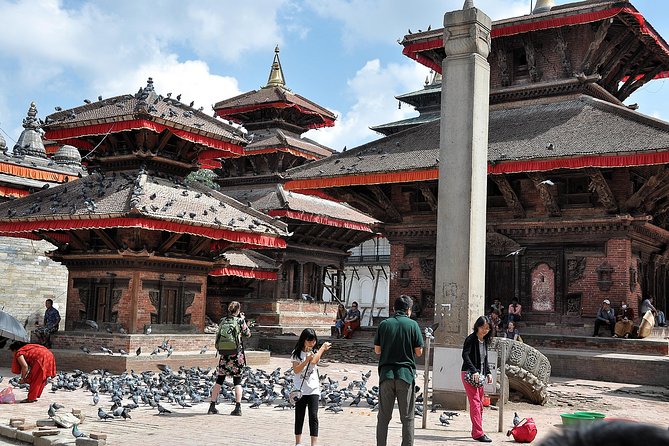
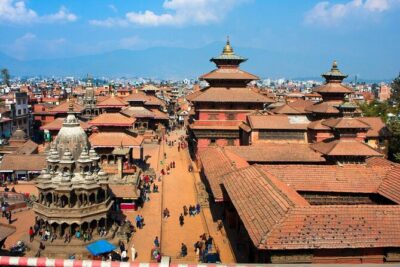
Kathmandu Durbar Square is the kind of place where you understand why Kathmandu is a World Heritage city. It’s tied to royal history: it was once a palace area connected to the Malla and Shan dynasties. Walking through, you can see how power, religion, and architecture blended into one ceremonial world.
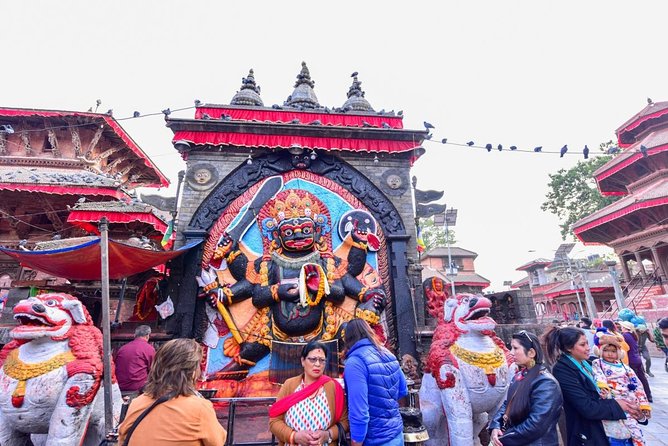
The visit focuses on a cluster of temples and sacred areas, including Kal Bhairav Temple, Taleju Temple, Kumari Bahal, Swet Bhirav Temple, Akash Bhirav Temple, and Shiv-Parvati Temple. That list matters because it signals the tour’s approach: you’re not only checking one monument, you’re seeing multiple shrines that fit together like pieces of a larger complex.
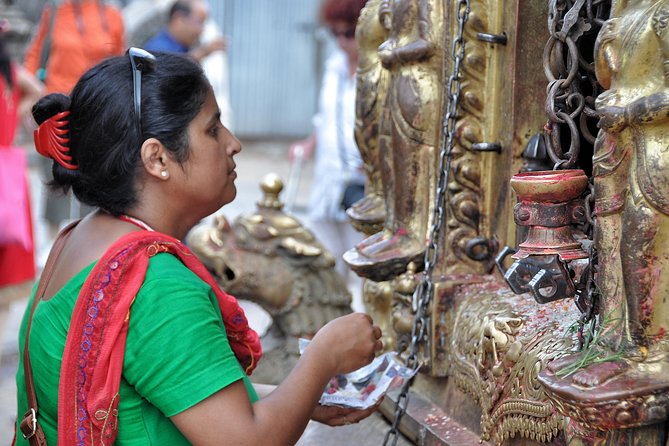
My favorite specific moment here is Kumari Bahal, the home of the living goddess of Nepal. There’s a queue, and the whole idea is that people line up to get a glimpse. If you like cultural rituals and how living tradition is treated with reverence, this is the emotional highlight of Durbar Square.
What to consider: Durbar Square can be intense. You’ll likely be sharing space with crowds near the most famous shrines, especially around the living goddess area. With only an hour here, you’ll want to let your guide help you prioritize what to look at first so you don’t spend the best part of your time stuck waiting rather than exploring.
Also, this stop is packed with religious meaning. If you’re the type who enjoys hearing the “why” behind architecture and deities, this is a strong match for you.
Swayambhunath Monkey Temple: city views and hidden symbol details
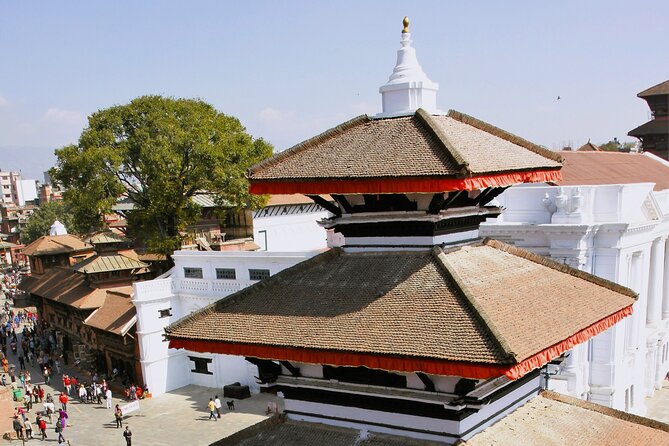
Swayambhunath is also known as the Monkey Temple, and the big reason it’s worth your time is the view. The site sits northwest of Kathmandu Valley and looks over the city, so you get a sense of where Kathmandu sits in the wider bowl of the valley.
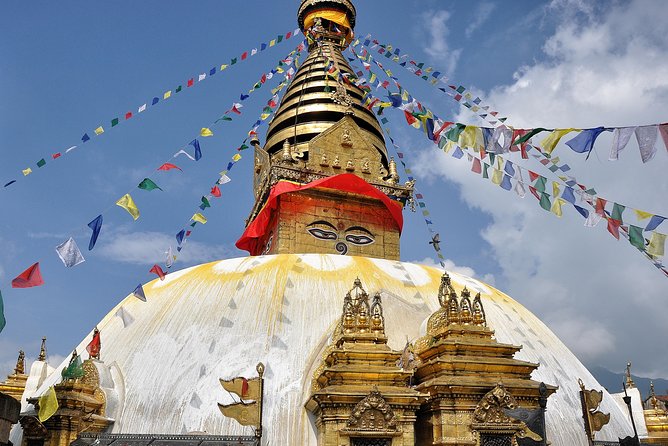
This stop is religiously layered. You’ll learn that Swayambhu means self-existent, and the stupa includes eyes on all sides. Those eyes symbolize awareness, faith, and peace, which gives you a clear way to interpret what you’re seeing instead of treating it like just another decorative stupa.
The tour also calls out architectural features that help you “read” the place:
- In the east, you’ll see a gold-plated Vajra.
- In the west, there’s a Buddhist statue.
- There’s also a temple of goddess Harati, believed to have been an ogress later converted into a caretaker of all children by Lord Buddha.
That Harati detail is a good example of why a guide adds value here. Myth and symbolism are built into the layout, and without explanation, you can miss what makes one corner different from another.
You’ll also enjoy the Dewa Dharma Monastery area, with Buddha statues and Tibetan paintings. If you’re into visual storytelling, this is where the religious art helps you slow down a bit.
Trade-off: Swayambhunath is popular. The views and stupa symbolism draw people in, so it can feel busy even if you’re only there for about an hour. If you’re chasing solitude, this stop may not be the best fit. If you want perspective and meaning, it’s a strong one.
Boudhanath Stupa: one huge mandala and a ritual you can join
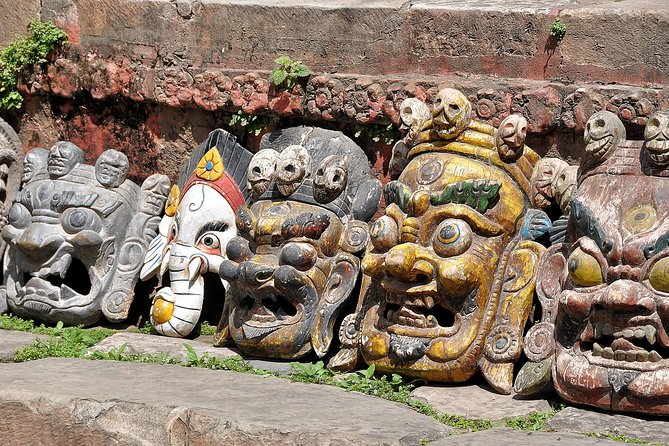
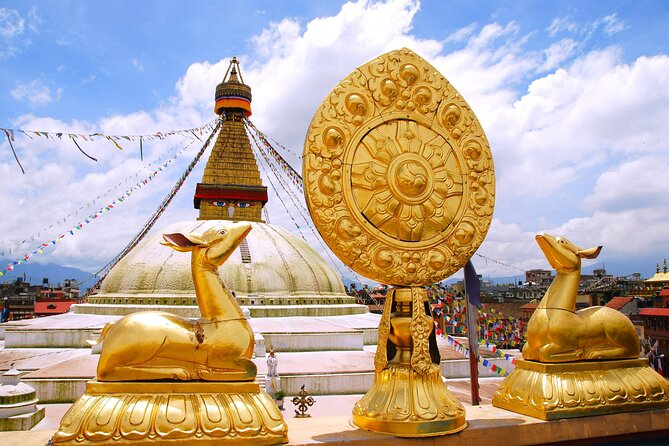
Boudhanath Stupa is described as the largest and holiest stupa in South East Asia. Even if you’ve seen stupa images before, this one lands differently because it’s massive—built as a giant mandala with symbols of enlightenment.
One specific detail that’s easy to remember is the five elements engraved in the architecture: earth, water, space, fire, and air. That matters because it turns the stupa from a single object into a map of symbolic meaning.
As you enter, you’ll see the stupa surrounded by a 16-sided wall. Around it, monks praying are part of the atmosphere, and that’s where the site becomes more than sightseeing. There are also monasteries nearby, like Shechen Monastery.
The experience also gives you a practical social space: the area near Boudhanath has broad areas with cafes and restaurants. The key point is that you can grab food later or simply take a calmer moment facing the stupa while it continues to feel sacred and active.
The main activity here is circulating the stupa clockwise direction while chanting Om Mani Padme Hum. That’s a big deal for first-time visitors because it’s a living practice, not just a photo moment.
Possible drawback: if you’re short on time or prefer quiet, the route around the stupa can feel like it has a “flow” you’ll need to fit into. Your hour needs to cover seeing, listening, and moving with the crowd. A guide helps you choose the best rhythm so you don’t feel lost.

Pashupatinath Temple: Shiva at a huge scale on the Bagmati River
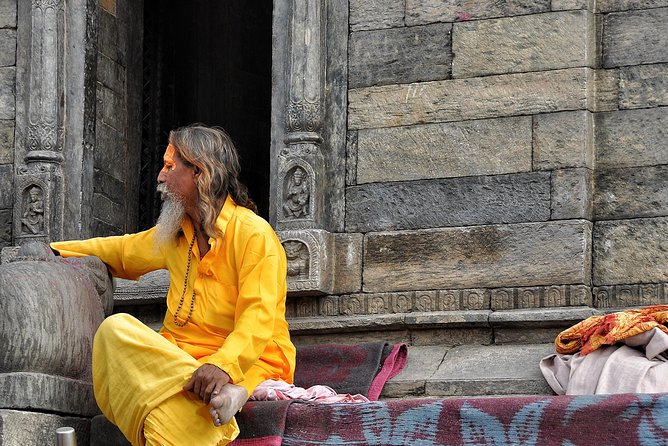
Pashupatinath Temple is a sacred Hindu temple on the Bagmati River banks, and it’s described as the largest temple in Nepal. This stop is powerful because you’re seeing a religious center that’s both grand and complex, not just a single temple building.
What makes it especially striking for visitors is the scale:
- 492 temples
- 15 Lord Shiva shrines
- 12 Jyotirlinga (phallic shrines)
Your guide will take you to what’s relevant within that complex. That matters because Pashupatinath is the kind of place where wandering without context can turn into aimless walking. With a structured visit, you get to experience more of the site’s meaning instead of only what’s immediately obvious.
The guide also helps with the “blend” aspect. Pashupatinath is framed as a mix of cultural and spiritual significance, and the architecture itself is described as beautiful. That’s useful because it means you should expect both human ritual and architectural detail.
Trade-off: this is another major pilgrimage area, so expect crowds. It’s also an active sacred setting, so the tour’s strength is that it gives you a planned time block rather than leaving you to figure it out alone.
If you’re most interested in Hindu architecture and Shiva-related traditions, this is likely the emotional and visual peak of the afternoon.
Price and value: what $120 buys you (and why it’s fair)
At $120 per person for a 4 to 6 hour private tour, the value really comes down to what’s included.
You get:
- An air-conditioned private vehicle with hotel pickup and drop-off
- A professional tour guide
- Entrance coverage for Kathmandu Durbar Square, Swayambhunath, Boudhanath, and Pashupatinath
Then you don’t get:
- Airport pickup and drop-off
- Food and drinks
- Accommodations
For a city tour, transport + guide time + entrance fees can add up quickly if you’re booking piece by piece. Here, those big moving parts are bundled, and that’s why the price works. You pay for convenience and time, but you’re also paying for meaning: four major sites, linked together by a guide so the trip makes sense as one story.
The other “value” factor is the private setup. You’re not competing with a group that has a different pace or attention level. If you want a calmer, more guided feel in a busy destination, that’s where the money usually feels well spent.
Who should book this tour, and who might skip it
This is a strong fit if you want a structured taste of Kathmandu’s spiritual and cultural core without planning routes, entry logistics, and timing yourself. If your priority is seeing major World Heritage sites—Durbar Square, Swayambhunath, Boudhanath, and Pashupatinath—this format is practical.
It’s also a good choice for people who like a guide who can explain what you’re looking at and keep you moving. The tour is described as run by Escape Himalaya Trek and Expedition, and their wider Nepal operation has a high satisfaction record (5 stars, 100% recommended across 59 reviews). In practice, that kind of track record often shows up as guides who communicate well and run trips smoothly, which is exactly what you want for multi-stop religious sites.
I’d hesitate if you prefer long unstructured time at one place, because the itinerary is clearly built for four stops in one morning-to-early-afternoon block. If you want slow, deep exploration of only one temple complex, you might feel rushed.
Should you book the Kathmandu Guided Tour?
Yes, if you want a high-impact introduction to Kathmandu’s religious side with the heavy lifting handled for you. The combination of hotel pickup, air-conditioned transport, a professional guide, and entrance coverage makes it easy to fit into a travel schedule.
Book it if:
- You want a connected route through four World Heritage sites
- You’d rather learn symbols and history than just take photos
- You’re okay with a tight time block and moving at a guided pace
Consider skipping (or pairing with extra time on your own) if:
- You want lots of quiet, slow wandering
- You plan to spend all your time at only one complex and go deep there
If your goal is to see the big spiritual Kathmandu hits in a single morning without stress, this tour is built for that.
FAQ
How long is the Kathmandu Guided Tour?
The tour is listed as approximately 4 to 6 hours.
How much does the tour cost?
It costs $120.00 per person.
What’s included in the price?
The package includes air-conditioned private vehicle with hotel pickup and drop-off, a professional tour guide, and entry/admission for Kathmandu Durbar Square, Boudhnath Stupa, Swayambhunath, and Pashupatinath Temple.
Is a mobile ticket provided?
Yes, the tour includes a mobile ticket.
Is the tour private?
Yes, it’s a private tour/activity and only your group participates.
Does the tour include food and drinks?
No. Food and drinks are not included.
What are the tour operating hours?
The tour runs Monday through Sunday from 7:45 AM to 1:15 PM.
What if weather is poor?
The experience requires good weather. If it’s canceled due to poor weather, you’ll be offered a different date or a full refund.
Simpler With a Local Guide

More Tours in Kathmandu



More Tour Reviews in Kathmandu

Just Reviewed in Kathmandu
- Mountain Bike Tour
★ 5.0 · 3 reviews - Annapurna Panaroma
★ 5.0 · 3 reviews - Mount Everest Scenic Flight 50 Minutes
★ 5.0 · 3 reviews - Kathmandu : Swambhunath & Durbar Square Guided Half Day Tour
★ 3.3 · 3 reviews - Chandragiri Cable Car & Monkey Temple Tour – Private/Group
★ 5.0 · 3 reviews - Kathmandu: Shivapuri National Park Hiking Day Trip
★ 3.3 · 3 reviews
Guided, compared.
 ★ 4.9Private City Guided TourFrom $40174 reviews
 ★ 5.0Full Day Guided Tour in KathmanduFrom $561 reviews
 ★ 5.012 Day Everest Base Camp Guided TrekFrom $1,30040 reviews
 ★ 5.0Kathmandu and Bhaktapur Cities Guided TourFrom $7034 reviews
 ★ 5.0Kathmandu Heritage Day Tour with Guide.From $7030 reviews
 ★ 5.0Everest Base Camp Trek 15 days | Local Guide | Flexible ItineraryFrom $1,89027 reviews
 ★ 5.012-Day Everest Base Camp Guided TrekkingFrom $1,00226 reviews
 ★ 5.05 Day Private Guided Trekking in Annapurna Base CampFrom $22525 reviews