
Review · ANNAPURNA CIRCUIT TREKS
20 Days Annapurna Circuit Trek
Annapurna Circuit is the trek that keeps surprising you. You get big mountain views, real village life, and a dramatic altitude shift over two-plus weeks. The route is also built around practical days like acclimatization in Manang and an early start for the 5,416-meter Thorong La Pass.
What I like most is that this trip has the key moving parts handled: airport transfers, Kathmandu sightseeing, and guided trekking with a porter system (2 guests per porter, 25 kg max). You’ll also get the legal paperwork that matters on the ground, including the ACAP permit and TIMS card, which helps your trek run smoothly without scrambling.
One consideration: you’re signing up for real altitude and long days—especially the pass day—so you’ll want a steady fitness baseline. If you get nervous in cold wind or you hate steep uphill starts, plan to take the itinerary seriously and move at a careful pace.
In This Review
- Key highlights to know before you go
- Why the Annapurna Circuit feels like multiple worlds
- Price and logistics: what $1,200 covers (and what it doesn’t)
- Days 1–2 in Kathmandu: temples, stupa silence, and getting your bearings
- Day 3 drive to Syange: a long transfer that sets the pace
- Trek days 4–7: from farm terraces to Manang’s big views
- Day 8 in Manang: acclimatization that actually helps
- Day 9–10: Yak Kharka and the push toward Thorong High Camp views
- Thorong La Pass day: early start, steep effort, and the long descent to Muktinath
- Day 12–14: Marpha, Ekale Bhatti, Tukuche, and the vegetation flip to forests
- Day 15–17: Ghorepani, the Poon Hill sunrise hike, and the walk into Pokhara
- Day 18–20: Pokhara lakes, scenic return drives, and airport transfer timing
- Guides and porter support that can make or break a circuit
- Practical altitude reality check and what to do with it
- Should you book this 20 Days Annapurna Circuit trek?
- FAQ
- What does the tour price include?
- Where does the trek start, and what time?
- Is this a private tour?
- What permits are included for the trek?
- Are Kathmandu sightseeing entrance fees included?
- Does the itinerary include Thorong La Pass?
- How is the return to Kathmandu handled?
- What is the cancellation window for a full refund?
Key highlights to know before you go
- Kathmandu warm-up with major heritage sites before you leave for the mountains
- Permits included (ACAP + TIMS) so you’re not hunting documents mid-trip
- Manang acclimatization day with time to explore local life and adjust to altitude
- Thorong La Pass timing set up for an early summit attempt before strong cold winds
- Vegetation change from high desert to forest as you cross the circuit’s midsection
- Poon Hill sunrise option from the Ghorepani area for a high-impact view stop
More trails out of Kathmandu, boots ready
- Everest Base Camp Trek – 14 Days★ 5.0 · 1,499 reviews
- Everest Base Camp Trek★ 5.0 · 842 reviews
- Everest Base Camp Trekking★ 5.0 · 485 reviews
- Nagarkot Sunrise View and Day Hiking from Kathmandu★ 5.0 · 471 reviews
Why the Annapurna Circuit feels like multiple worlds
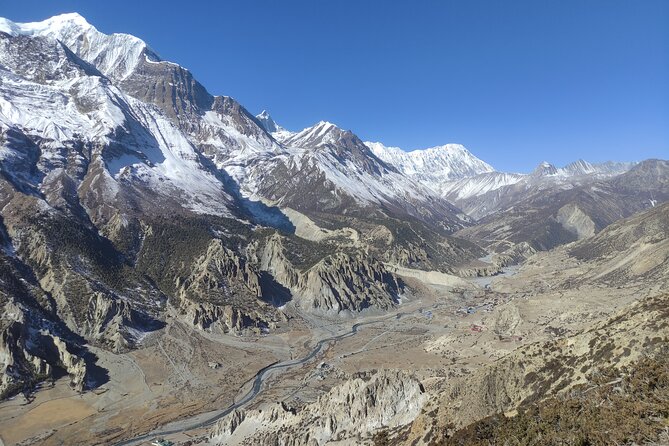
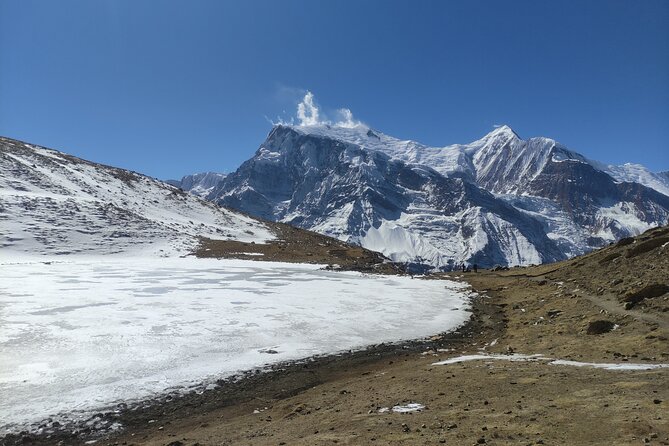
The Annapurna Circuit isn’t just one kind of trekking day. You’ll watch the environment shift from lower, warmer areas into a colder high-altitude world, and the change can feel fast. That’s part of what makes the circuit so memorable: your senses stay busy even when you’re simply walking.
The scenery is also tied to the rhythm of the trek. You’re not only climbing toward a pass—you’re also traveling through valleys and settlements where daily life continues at mountain speed. Add the iconic crossing at Thorong La, and you end up with a journey that feels like a long story with a big payoff.
And yes, you should expect snow-capped peaks to appear in phases as elevation increases. The route is paced to let those views build rather than dump everything on you on day one.
Price and logistics: what $1,200 covers (and what it doesn’t)
At $1,200 per person for roughly 20 days, the value mostly comes from the “set-up” costs that can be annoying to manage alone. This price includes airport pickup and drop, Kathmandu sightseeing by car, and the main overland transport into the trek area (Kathmandu to Besisahar by regular bus, then Besisahar to Syange by sharing jeep).
It also includes the people who carry the trip: a professional trekking guide (government licensed) plus a porter system. You’ll have a ratio of 2 guests per porter, with a maximum of 25 kg per porter—huge for comfort when you’re moving uphill day after day.
Finally, you get the paperwork that trekking companies handle for you: ACAP permit and TIMS card. Those aren’t glamorous, but they’re essential for an official trek.
What’s not included is equally important. Drinks aren’t covered, and tips, rescue/evacuation costs, and personal expenses are on you. Also, several major Kathmandu sites have entry fees you’ll pay separately, and the pass and trek logistics don’t include any special accommodation upgrades.
Days 1–2 in Kathmandu: temples, stupa silence, and getting your bearings
You start in Kathmandu with an easy landing day. After you arrive at Tribhuvan Airport, the Great Adventure Treks representative meets you and brings you to your hotel. That matters because Kathmandu can feel chaotic the first day; getting through the airport transfer without stress helps.
Day 2 is a smart cultural warm-up before hiking. You’ll visit Pashupatinath Temple on the Bagmati River, then move to Boudhanath Stupa, a UNESCO World Heritage site. From there, you head to Kathmandu Durbar Square, where former royal palaces once stood. These stops give you context for how people live in Nepal beyond the trekking routes.
The one trade-off: entry fees for Pashupatinath, Boudhanath, and Kathmandu Durbar Square are not included. If you want smooth sightseeing, set aside cash for those.
Day 3 drive to Syange: a long transfer that sets the pace
Day 3 is a travel day with real sitting time. After early breakfast, you go by road toward the trail area—first along the Pokhara highway route, then toward Syange. The timing can be lengthy, and the route description suggests around 10 hours total driving from Kathmandu, with additional road time once you’re closer to Besisahar.
You finish the day at Syange (823 meters). This overnight stop is practical: it breaks up the journey so your trek starts with less rushing and more time to settle in.
If you’re sensitive to long road travel, bring something to make the ride easier—water, a light snack, and anything that helps you stay comfortable.




Trek days 4–7: from farm terraces to Manang’s big views
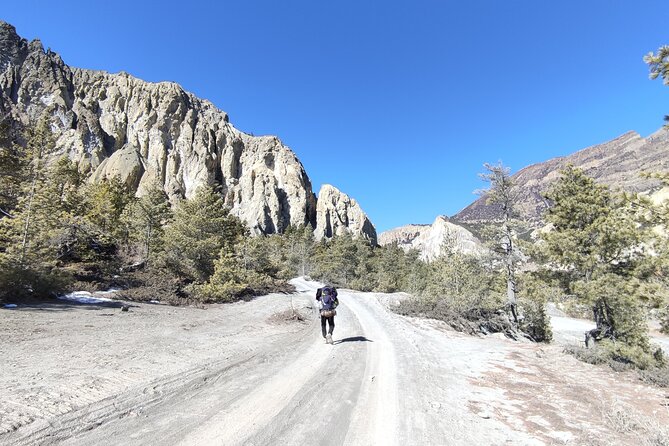
This is where the circuit starts to feel like a real trek. On Day 4, the trail begins around Besisahar with gorge and hillside scenery, plus waterfalls and snow-capped peaks. Early on, you’ll hit a steep section for a short period before the trail eases into lush farm terraces.
On Day 5, you transition into cooler air and a different vegetation pattern. The walk brings you through forest sections before reaching villages along the way, with Chame as the overnight stop.
Day 6 pushes you higher to Pisang (around 3,200 meters). The route description notes that you follow a river route on the northern bank, which tends to create an easy-to-follow walking rhythm: steady effort, then payoff when the peaks line up.
Day 7 continues upward to Manang. From Pisang onwards, the itinerary emphasizes constant mountain views, and you’ll climb steeply in the early part to reach the village.
Why this section matters: it builds your trekking legs without immediately throwing you into the hardest altitude day. You’re walking long hours, but the trek is still staged so your body can adapt step by step.
Day 8 in Manang: acclimatization that actually helps
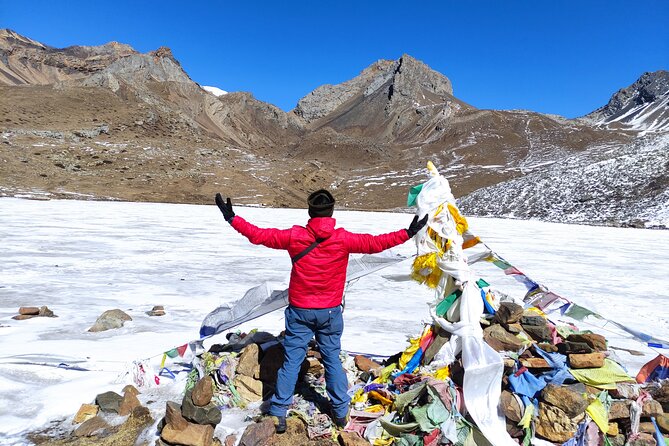
Manang is your acclimatization day. Instead of treating it as a boring pause, the plan gives you time to explore the area around a village with roughly 500 flat-roofed houses. This kind of stop helps because altitude doesn’t forgive speed.
The best part of Manang, practically speaking, is that it’s a chance to rest without losing momentum. You get to hydrate, eat well, and get your bearings before the trek stretches into higher, more barren terrain.
Also, you’ll be positioned well for the next stages where the air gets thinner and the views get sharper.
Day 9–10: Yak Kharka and the push toward Thorong High Camp views
After Manang, the trek moves toward more exposed walking. Day 9 climbs slowly from Manang toward Yak Kharka, and the route describes inspiring views of Annapurna II, Gangapurna, Tilicho, and Chuli. You’re also walking through windswept, barren areas—great for views, tougher for comfort if the weather turns.
Day 10 is described as a slow climb to the last settlement of Ledar, with the day framed around Thorong High Camp viewpoint area scenery. This is the “just keep going” stage where you conserve energy and avoid overreaching.
Two practical notes here. First, bring layers you can adjust quickly because mountain temperatures can change minute to minute. Second, treat these two days like training for the pass day—not as days to set records.
Thorong La Pass day: early start, steep effort, and the long descent to Muktinath
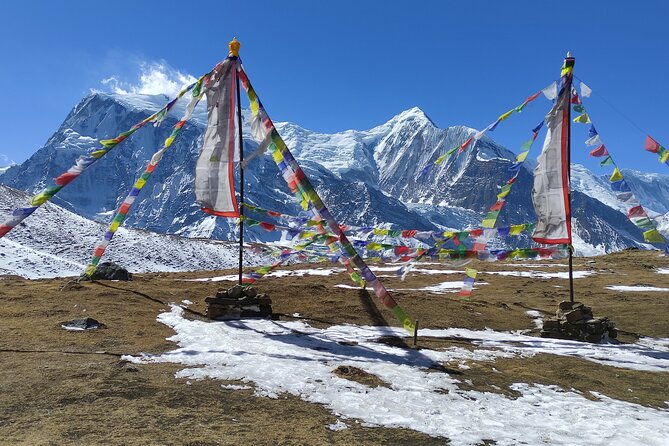
This is the big day. You start early so you can reach Thorong La Pass (5,416 meters) before cold winds ramp up. The itinerary highlights how the first part can feel strenuous and steep, so the plan is built around getting you through the hardest part while conditions are still workable.
Once you cross, the descent takes you to Muktinath Temple area (around 3,800 meters). The route description calls out that this is often the longest day in terms of overall trekking, and it also includes a practical note: at the bottom you’ll find about two or three teahouses for refreshment.
If you want to do well here, pacing is everything. You’ll feel time pressure from the altitude and weather, but pushing hard usually backfires. Aim for steady breath control early so your legs still have enough to handle the descent.
Day 12–14: Marpha, Ekale Bhatti, Tukuche, and the vegetation flip to forests
After Muktinath, Day 12 drops you fast—about 1,200 meters—to the Kali Gandaki river valley floor. The plan includes a brief stop at Ekale Bhatti, a small settlement described as a lonely teahouse area with only a few houses. It’s the kind of pause that helps you break up the descent.
Day 13 continues downstream toward Tukuche village, under the towering presence of Tukuche peak and Dhaulagiri. The walking is described as enjoyable along the Kali Gandaki river, and this stretch tends to feel more navigational and scenic rather than purely uphill grind.
Day 14 brings a major environmental shift. The trail moves from dry, arid high areas into pine and conifer forests, passing between Dhaulagiri and Annapurna. You get the sense that the circuit is not only altitude—it’s weather and vegetation zones changing as you move around the massif.
This section is valuable because your trek begins to feel less like climbing toward one goal and more like traveling through a living system.
Day 15–17: Ghorepani, the Poon Hill sunrise hike, and the walk into Pokhara
After Tatopani, you head to Ghorepani (around 2,860 meters) on a 6–7 hour trail. A fun detail here is the mention of crossing a suspension bridge over the Kali Gandaki River, which usually delivers both photo chances and a quick adrenaline bump.
Day 16 adds a daytime option (weather permitting): hike up toward Poon Hill (around 3,195 meters) for a sunrise panorama. The view described spans multiple ranges, including Dhaulagiri and Annapurna, plus Mt. Manaslu range in the wider sweep. Even if sunrise doesn’t fully land, the area is still a solid high-view break.
That day then continues toward Tikhedhunga for overnight, setting you up for the final trekking day.
Day 17 finishes the circuit walk into Pokhara. The description notes rural farm villages, plus views of nearby waterfalls. It’s a nice transition from high-altitude trekking energy into a town that feels easier to breathe in.
Day 18–20: Pokhara lakes, scenic return drives, and airport transfer timing
Day 18 is leisure day in Pokhara. You can do sightseeing around Phewa Lake, Begnas Lake, and Rupa Lake. Even without a packed schedule, Pokhara is useful for recovery—warm meals, easy walking, and the chance to sleep in proper comfort after days of altitude and trekking.
Day 19 brings the return to Kathmandu by bus, about 8 hours. The route passes scenic hills with views connected to the Trisuli and Marsyangdi Rivers, so it isn’t an endless blank drive. Still, it’s a long day, so save your energy for the evening.
Day 20 is the airport transfer. You’ll be taken to the international airport about 3 hours before your scheduled flight. That timing is worth respecting, especially if Nepal traffic or airport procedures run a bit unpredictably.
Guides and porter support that can make or break a circuit
This trek is private, meaning it’s just your group. You also get a government-licensed guide and a porter with the stated carry limit. For many people, that’s the difference between surviving a trek and enjoying it.
The most praised part of the company’s support is how helpful staff are on the ground. In prior Annapurna Circuit trips, guides named Jaya and porters named Malik and Dinesh were singled out for care and good teamwork. Another recurring positive note is that the company owner can speak Chinese very well and is described as kind and polite—useful if you want smoother communication during stressful parts of a mountain trek.
You shouldn’t expect perfection in every weather moment, but a good guide system helps you make the right calls when conditions change—especially during the pass day and the long descents.
Practical altitude reality check and what to do with it
This itinerary is aimed at people with moderate physical fitness. That’s encouraging, but you still need to respect the altitude profile. The summit milestone is Thorong La Pass at 5,416 meters, and even if you’re not sprinting, your body is doing work at thin air.
The itinerary wisely uses an acclimatization day in Manang, and it times the pass for an early start before cold winds. Those aren’t random choices; they’re basic risk reduction.
For your own preparation, focus on two things: stamina for long walking days and flexibility in how you pace. On the pass day, the plan expects a strenuous start and a long overall day with descent to Muktinath. On the approach days, the route includes slow climbs and windswept terrain, so staying warm and hydrated matters.
Also, remember drinks are not included—so plan to budget for water and any other beverages you want.
Should you book this 20 Days Annapurna Circuit trek?
If you want a trekking route with real structure—permits handled, guide and porter support, staged acclimatization, and transportation stitched together—this is a solid pick. The itinerary covers the full arc: Kathmandu cultural start, high views building toward the pass, then a transition through different environments down to Pokhara.
Book it if:
- You want private, guided trekking with a porter system (2:1 and 25 kg max)
- You value Manang acclimatization and a clearly planned pass attempt
- You like the idea of mixing trekking days with a clear recovery base in Pokhara
Skip it or ask more questions if:
- You dislike long road transfers and long trekking days
- You know you’ll struggle with steep uphill starts or cold wind conditions around high passes
- You want everything fully inclusive, since drinks, entry fees, and tips are not covered
If you’re prepared for the altitude and you appreciate having logistics handled, this Annapurna Circuit package gives you a good chance to focus on the trail rather than the paperwork.
FAQ
What does the tour price include?
It includes airport pickup and drop, Kathmandu sightseeing by car, Kathmandu to Besisahar by regular bus and Besisahar to Syange by sharing jeep, a licensed trekking guide and a porter (2 guest 1 porter, 25 kg max), ACAP permit, TIMS card, and meals (breakfast 18 times, lunch 15 times, dinner 15 times). Drinks, visa, and tips are not included.
Where does the trek start, and what time?
The start is at the meeting point in Kathmandu with a start time of 8:15 am, and the activity includes transfers and ends back at the meeting point.
Is this a private tour?
Yes. It’s listed as private, so only your group participates.
What permits are included for the trek?
You get the Annapurna Conservation Area Project Permit (ACAP) and a TIMS card included.
Are Kathmandu sightseeing entrance fees included?
No. The Pashupatinath Temple entrance fee, Boudhanath Stupa entry fee, and Kathmandu Durbar Square entry fee are not included.
Does the itinerary include Thorong La Pass?
Yes. The pass is listed as a highlight, with Thorong La Pass at 5,416 meters, and the plan includes an early start to reach the top before cold winds.
How is the return to Kathmandu handled?
You’ll trek to Pokhara, then return to Kathmandu by bus (about 8 hours), and on the final day you’ll be transferred to the international airport about 3 hours before your flight.
What is the cancellation window for a full refund?
You can cancel up to 3 days in advance for a full refund. If you cancel less than 3 full days before the start time, the amount paid is not refunded.
More Trekking Out of Kathmandu






More Tour Reviews in Kathmandu




Just Reviewed in Kathmandu
- Mountain Bike Tour
★ 5.0 · 3 reviews - Annapurna Panaroma
★ 5.0 · 3 reviews - Mount Everest Scenic Flight 50 Minutes
★ 5.0 · 3 reviews - Kathmandu : Swambhunath & Durbar Square Guided Half Day Tour
★ 3.3 · 3 reviews - Chandragiri Cable Car & Monkey Temple Tour – Private/Group
★ 5.0 · 3 reviews - Kathmandu: Shivapuri National Park Hiking Day Trip
★ 3.3 · 3 reviews
Annapurna Circuit Treks, compared.
 ★ 5.0Annapurna Circuit Trek with Tilicho LakeFrom $1,093368 reviews
 ★ 5.0Annapurna Circuit TrekFrom $1,17594 reviews
★ 5.0Annapurna Circuit TrekFrom $2,24067 reviews
★ 5.0Annapurna Circuit TrekFrom $1,07449 reviews
★ 5.0Annapurna Circuit TrekFrom $1,35046 reviews
★ 5.0Annapurna Circuit TrekFrom $1,15035 reviews
★ 5.0Annapurna circuit TrekFrom $99835 reviews
★ 5.0Annapurna Circuit TrekFrom $97534 reviews
Browse the lists this tour appears in